
Unnumbered pageScan 2 of 83
Excavation at Bamboula
June 21to July 3, 1954 (JTD ix,iii-iii)
Summary of stratification in areas dug
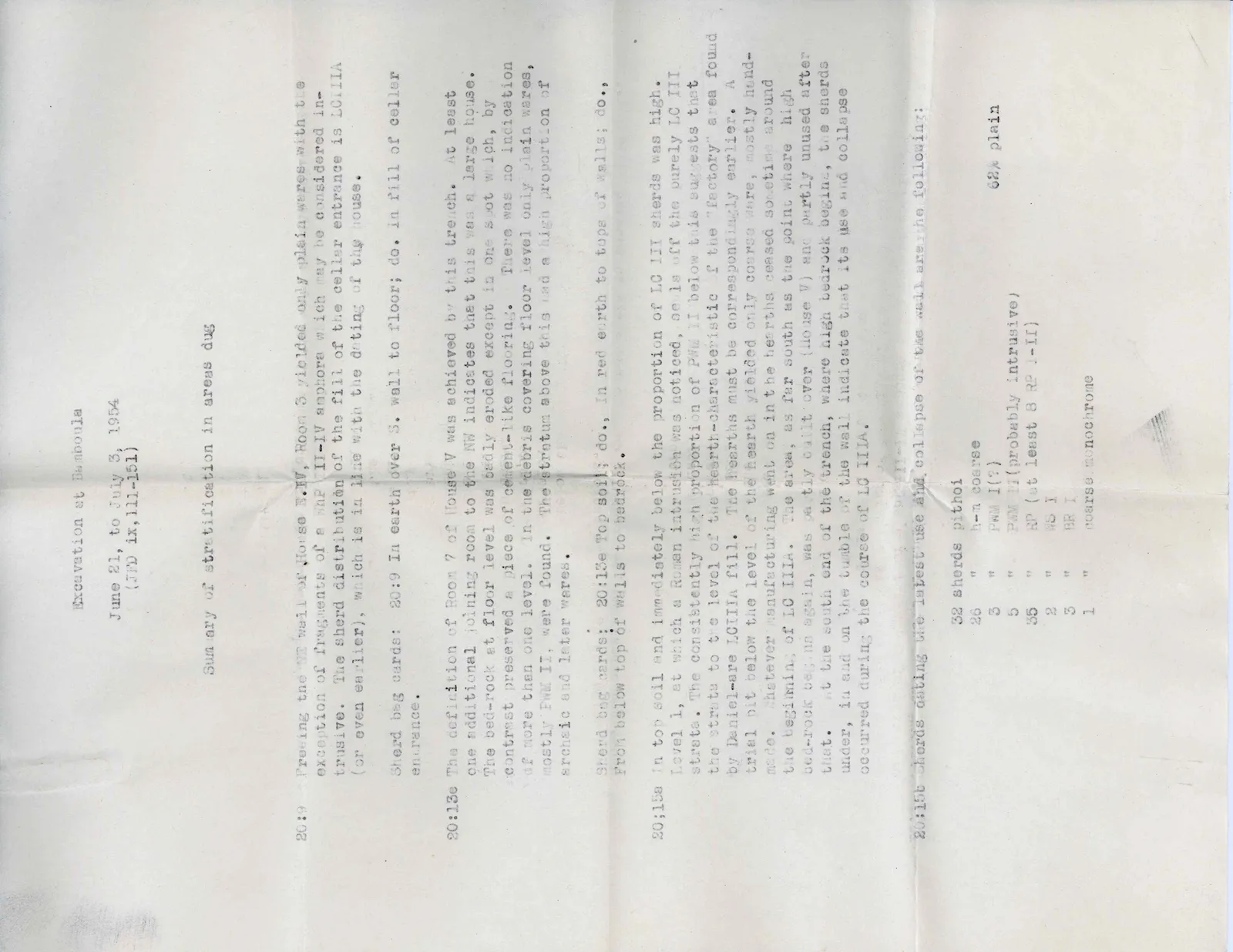
20:9 Pre-ing the NE wall of House E.IV, Room 3 yielded only plain wares with the exception of fragments of a PWM II-IV amphora which may be considered intrusive. The sherd distribution of the fill of the cellar entrance is LCIIIA (or even earlier), which is in line with the dating of the house.
Sherd bag cards: 20:9 In earth over S. wall to floor; do. in fill of cellar entrance.
20:13a The definition of Room 7 of House V was achieved by this trench. At least one additional joining room to the NW indicates that this was a large house. The bed-rock at floor level was badly eroded except in one spot which, by contrast preserved a piece of cement-like flooring. There was no indication of more than one level. In the debris covering floor level only plain wares, mostly PWM II, were found. The stratum above this had a high proportion of archaic and later wares.
Sherd bag cards: 20:13e Top soil; do.; In red earth to tops of walls; do. From below top of walls to bedrock.
20:15a In top soil and immediately below the proportion of LC III sherds was high. Level 1, at which a Roman intrusion was noticed, seals off the purely LC III strata. The consistently high proportion of PWM II below this suggests that the strata to the level of the hearth-characteristic of the "factory" area found by Daniel-are LCIIIA fill. The hearths must be correspondingly earlier. A trial pit below the level of the hearth yielded only coarse ware, mostly hand-made. Whatever manufacturing went on in the hearths ceased sometime around the beginning of LC IIIA. The area, as far south as the coin where high bed-rock begins, was partly unused after that. At the south end of the trench, where high bedrock begins, the sherds under, in and on the rubble of the wall indicate that its use and collapse occurred during the course of LC IIIA.
20:15b Sherds getting the latest use and collapse of the wall are the following:
32 sherds pithoi 26 " h-n coarse 5 " PWM I(?) 5 " PWM II(probably intrusive) 35 " RP (at least 8 RP I-II) 2 " WS I 3 " BR I 1 " coarse monochrome
62% plain
65 figures hard to readstruck struck outadded written in above” jug ditto, and what it repeatsword reading not certain