
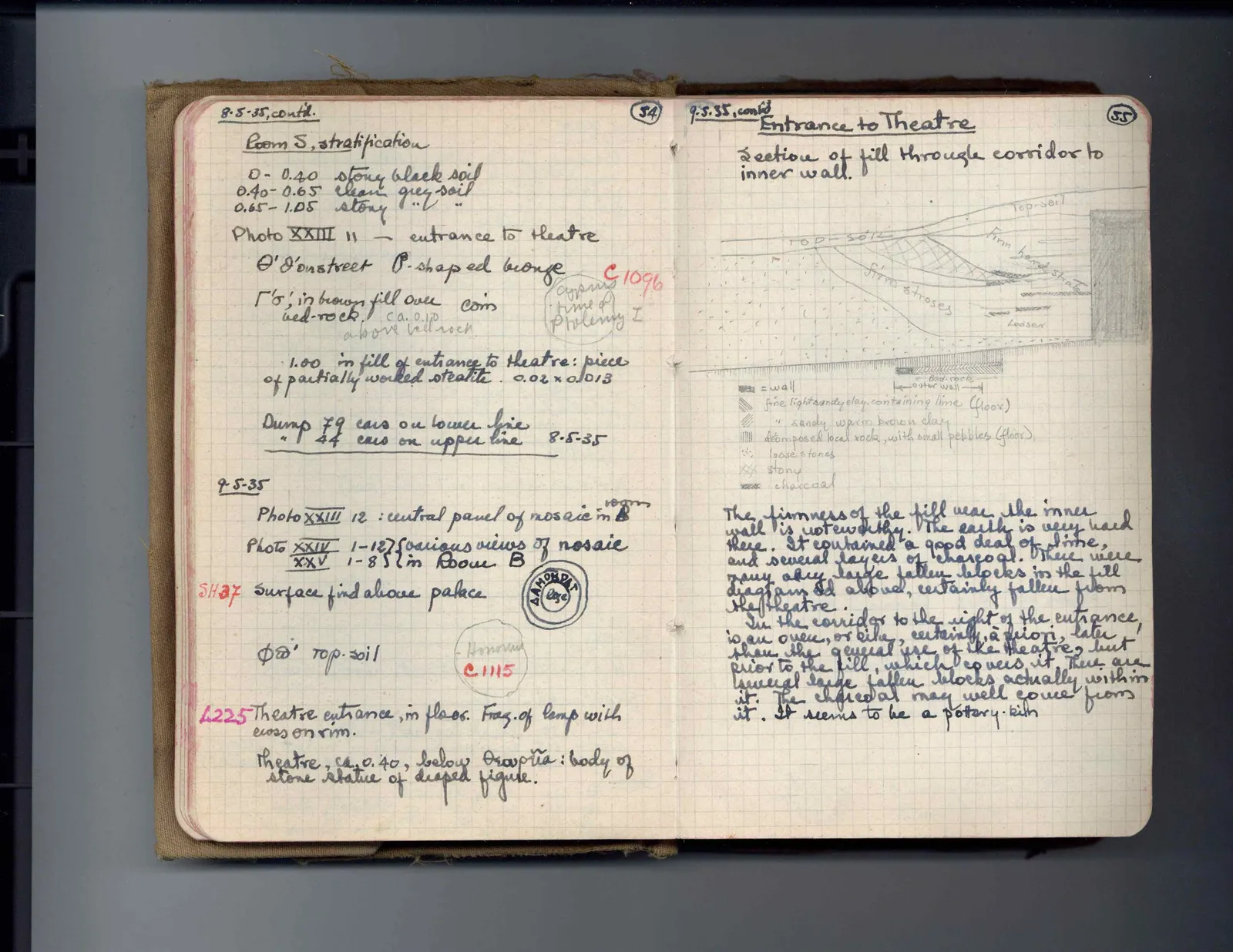
Page 54Scan 30 of 91
8.5.35cont'd._
Room 5, stratification 0- 0.40 stony black soil 0.40- 0.65 clean grey soil 0.65- 1.05 stony " "
Photo XXIII 11 - entrance to theatre
Red: C 1096
Θ'on street 8-shaped bronze [bracketed right: approx time of Ptolemy I] Γσ', in brown fill over com bed-rock, ca. 0.10 above bed rock
1.00 in fill of entrance to theatre: piece of partially worked steatite. 0.02 x 0.013
Dump 79 cars on lower line " 44 cars on upper line 8.5.35
9.5.35Photo XXIII 12: central panel of mosaic in Broom
Photo XXIV 1-12 XXV 1-8 } [bracket spanning both lines] various views of mosaic in Room B
[stamp: ΔΗΜΟΠΡΑΣΙΑ [illegible]] [red: Sh 27] Surface find above palace
Circular border: [pencil: Honorius
[red: C 1115]] Φδ' top. soil
[red: L 225] Theatre entrance, in floor. Frag. of lamp with cross on rim.
Theatre, ca. 0.40, below στρω̃μα: body of stone statue of draped figure.
Right page
9.5.35cont'd_ Entrance to Theatre Section of fill through corridor to inner wall.
Drawing: section diagram; labels: Top. soil, Firm hard strat., Top. soil, Firm stroses, Looser, [symbol] = wall, [symbol] = bed-rock, [arrow] outer wall [arrow], [symbol] = fine light sandy clay, containing lime (floor), [symbol] = " sandy warm brown clay, [symbol] = decomposed local rock, with small pebbles (floor), [symbol] = loose stones, [symbol] = stony, [symbol] = charcoal
The firmness of the fill near the inner wall is noteworthy. The earth is very hard there. It contained a good deal of lime, and several layers of charcoal. There were many very large fallen blocks in the fill (omitted above), certainly fallen from the theatre.
In the corridor to the right of the entrance, is an oven, or kiln, certainly, a priori, later than the general use of the theatre, but prior to the fill, which covers it. There are several large fallen blocks actually within it. The charcoal may well come from it. It seems to be a pottery-kiln
65 figures hard to readstruck struck outadded written in above” jug ditto, and what it repeatsword reading not certain