
Unnumbered pageScan 4 of 18
REFERENCES TO EPISKOPI IN HILL'S HISTORY OF CYPRUS.
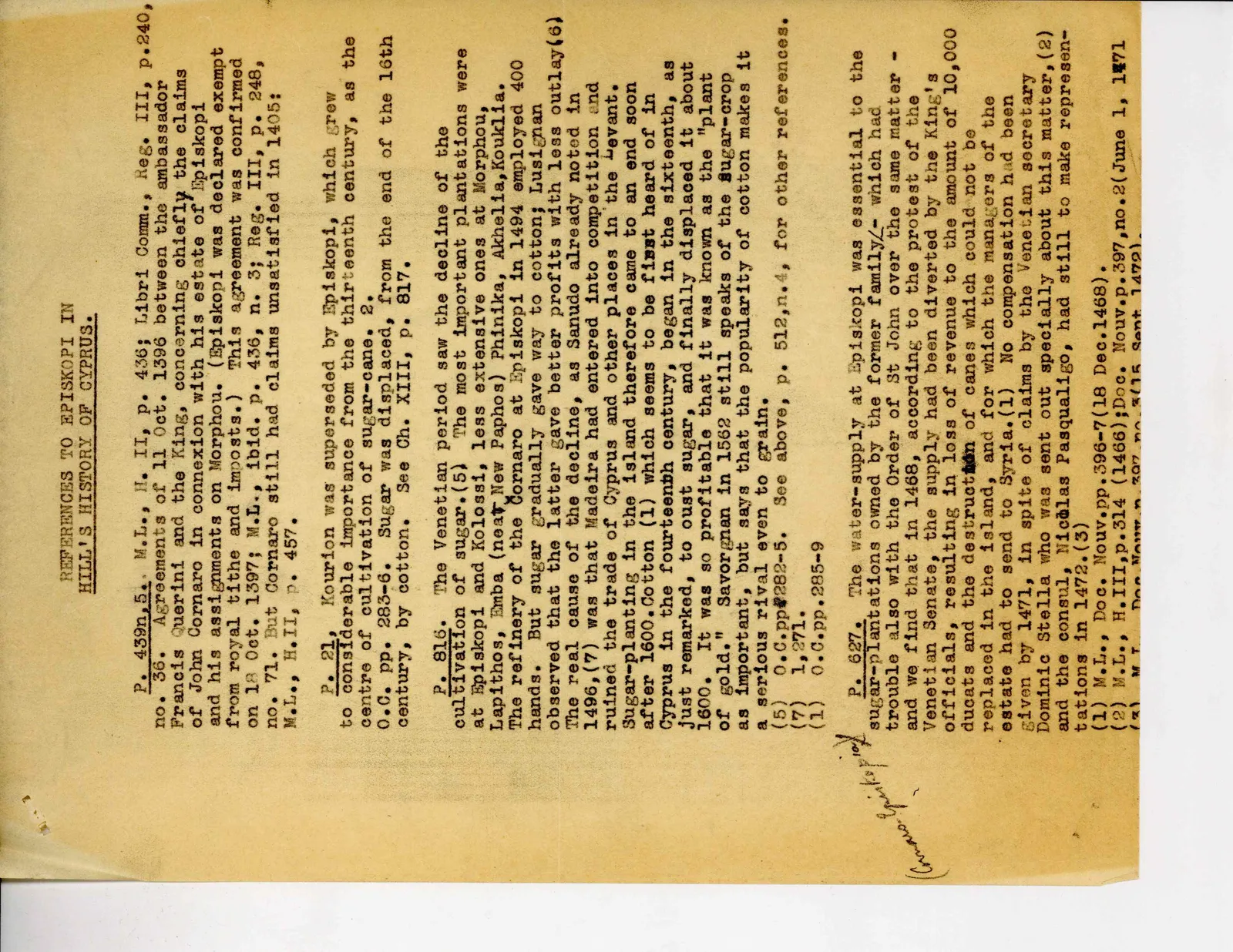
P. 439n.5. M.L., H. II, p. 436; Libri Comm., Reg. III, p.240, no. 36. Agreements of 11 Oct. 1396 between the ambassador Francis Querini and the King, concerning chiefly the claims of John Cornaro in connexion with his estate of Episkopi and his assignments on Morphou. (Episkopi was declared exempt from royal tithe and imposts.) This agreement was confirmed on 18 Oct. 1397; M.L., ibid. p. 436, n. 3; Reg. III, p. 248, no. 71. But Cornaro still had claims unsatisfied in 1405: M.L., H.II, p. 457.
P. 21. Kourion was superseded by Episkopi, which grew to consider considerable importance from the thirteenth century, as the centre of cultivation of sugar-cane. 2. O.C. pp. 283-6. Sugar was displaced, from the end of the 16th century, by cotton. See Ch. XIII, p. 817.
P. 816. The Venetian period saw the decline of the cultivation of sugar.(5) The most important plantations were at Episkopi and Kolossi, less extensive ones at Morphou, Lapithos, Emba (neat New Paphos) Phinika, Akhelia, Kouklia. The refinery of the Cornaro at Episkopi in 1494 employed 400 hands. But sugar gradually gave way to cotton; Lusignan observed that the latter gave better profits with less outlay(6) The real cause of the decline, as Sanudo already noted in 1496,(7) was that Madeira had entered into competition and ruined the trade of Cyprus and other places in the Levant. Sugar-planting in the island therefore came to an end soon after 1600. Cotton (1) which seems to be first heard of in Cyprus in the fourteenth century, began in the sixteenth, as just remarked, to oust sugar, and finally displaced it about 1600. It was so profitable that it was known as the "plant of gold." Savorgnan in 1562 still speaks of the sugar-crop as important, but says that the popularity of cotton makes it a serious rival even to grain. (5) O.C.pp.282-5. See above, p. 512,n.4, for other references. (7) 1,271. (1) O.C.pp.285-9
P. 627. The water-supply at Episkopi was essential to the sugar-plantations owned by the former family/- which had trouble also with the Order of St John over the same matter - and we find that in 1468, according to the protest of the Venetian Senate, the supply had been diverted by the King's officials, resulting in loss of revenue to the amount of 10,000 ducats and the destruction of canes which could not be replaced in the island, and for which the managers of the estate had to send to Syria.(1) No compensation had been given by 1471, in spite of claims by the Venetian secretary Dominic Stella who was sent out specially about this matter,(2) and the consul, Nicolas Pasqualigo, had still to make representations in 1472.(3) (1) M.L., Doc. Nouv.pp.396-7(18 Dec.1468). (2) M.L., H.III,p.314 (1466);Doc. Nouv.p.397,no.2(June 1, 1471 (3) M.L., Doc.Nouv.p.397,no.3(15 Sept.1472).
65 figures hard to readstruck struck outadded written in above” jug ditto, and what it repeatsword reading not certain