
Unnumbered pageScan 77 of 104
Kaloriziki T 41
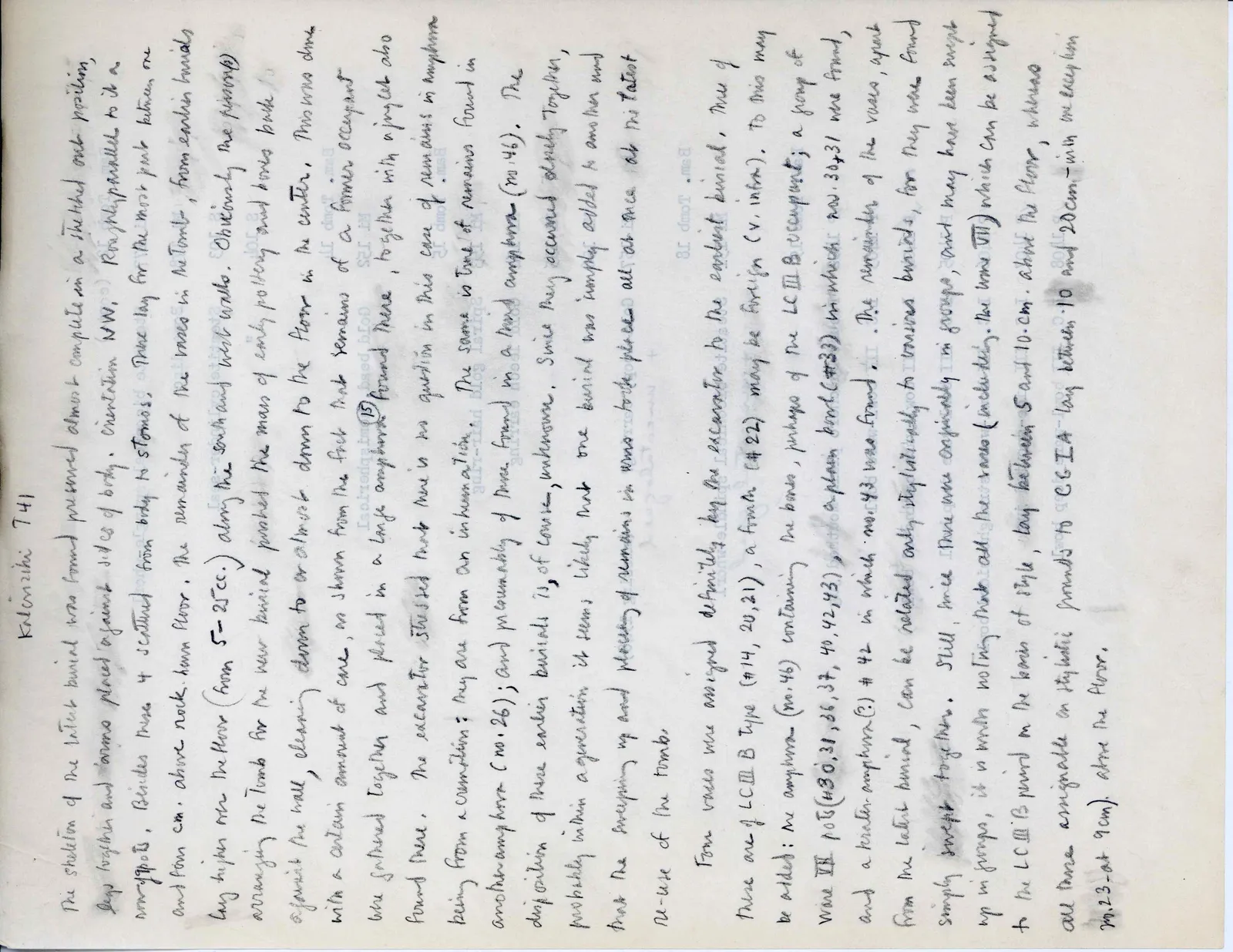
The skeleton of the latest burial was found preserved almost complete in a stretched out position, legs together and arms placed against sides of body. Orientation NW. Roughly parallel to it a row of 19 pots. Besides these 4 scattered from body to stomios. These lay for the most part between one and four cm. above rock-hewn floor. The remainder of the vases in the tomb, from earlier burials lay higher on the floor (from 5-25 cc.) along the south and west walls. Obviously the persons arranging the tomb for the new burial pushed the mass of early pottery and bones back against the wall, clearing down to or almost down to the floor in the center. This was done with a certain amount of care, as shown from the fact that remains of a former occupant were gathered together and placed in a large amphora 15)/ found there, together with a juglet also found there. The excavator stressed that there is no question in this case of remains in amphora being from a cremation: they are from an inhumation. The same is true of remains found in another amphora (no. 26); and presumably of those found in a third amphora (no. 46). The disposition of these earlier burials is, of course, unknown. Since they occurred closely together, probably within a generation, it seems likely that one burial was simply added to another and that the sweeping up and placing of remains in urns took place all at once at the latest re-use of the tomb.
Four vases were assigned definitely by the excavator to the earliest burial. Three of these are of LC III B type (#14, 20, 21), a fourth (#22) may be foreign (v. infra). To this may be added: the amphora (no. 46) containing the bones, perhaps of the LC III B occupant; a group of Ware VII pots (#30, 31, 36, 37, 40, 42, 43), a plain bowl (#33) in which no. 30 + 31 were found, and a krater amphora (?) #42 in which no. 43 was found. The remainder of the vases, apart from the latest burial, can be related only stylistically to various burials, for they were found simply swept together. Still, since these were originally in groups, and may have been swept up in groups, it is worth noting that all the vases (including the Ware VII) which can be assigned to the LC III B period on the basis of style, lay between 5 and 10 cm. above the floor, whereas all those assignable on stylistic grounds to C G I A lay between 10 and 20 cm - with one exception (no. 23 - at 9 cm) above the floor.
65 figures hard to readstruck struck outadded written in above” jug ditto, and what it repeatsword reading not certain