
Unnumbered pageScan 4 of 31
4
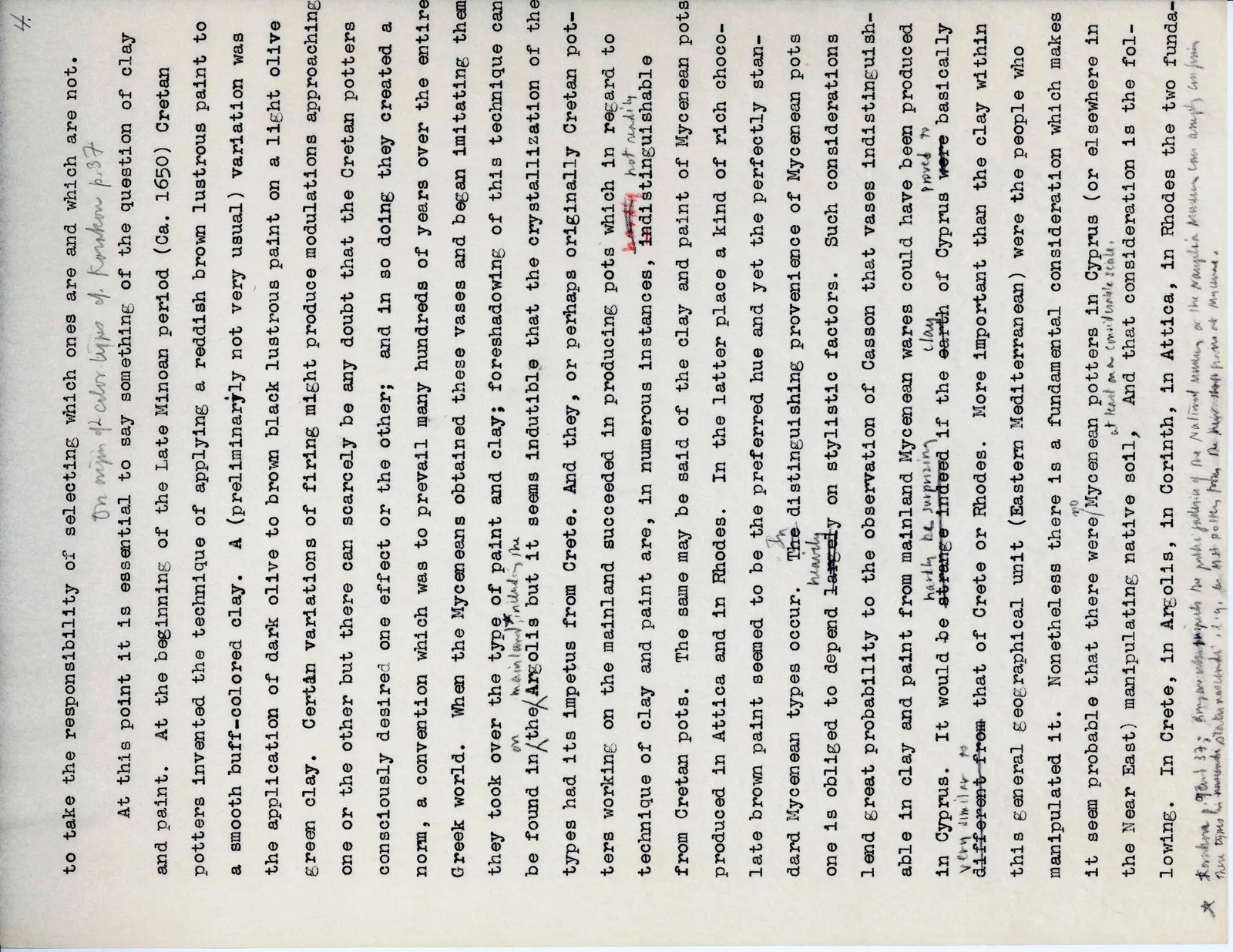
to take the responsibility of selecting which ones are and which are not. At this point it is essential to say something of the question of clay and paint. At the beginning of the Late Minoan period (Ca. 1650) Cretan potters invented the technique of applying a reddish brown lustrous paint to a smooth buff-colored clay. A (preliminarily not very usual) variation was the application of dark olive to brown black lustrous paint on a light olive green clay. Certain variations of firing might produce modulations approaching one or the other but there can scarcely be any doubt that the Cretan potters consciously desired one effect or the other; and in so doing they created a norm, a convention which was to prevail many hundreds of years over the entire Greek world. When the Mycenaeans obtained these vases and began imitating them they took over the type of paint and clay; foreshadowing of this technique can be found in [the] Argolis but it seems indubitble that the crystallization of the types had its impetus from Crete. And they, or perhaps originally Cretan potters working on the mainland succeeded in producing pots which in regard to technique of clay and paint are, in numerous instances, indistinguishable from Cretan pots. The same may be said of the clay and paint of Mycenean pots produced in Attica and in Rhodes. In the latter place a kind of rich chocolate brown paint seemed to be the preferred hue and yet the perfectly standard Mycenean types occur. The distinguishing provenience of Mycenean pots is obliged to depend largely on stylistic factors. Such considerations lend great probability to the observation of Casson that vases indistinguishable in clay and paint from mainland Mycenean wares could have been produced in Cyprus. It would be strange indeed if the earth of Cyprus were basically different from that of Crete or Rhodes. More important than the clay within this general geographical unit (Eastern Mediterranean) were the people who manipulated it. Nonetheless there is a fundamental consideration which makes it seem probable that there were Mycenean potters in Cyprus (or elsewhere in the Near East) manipulating native soil, and that consideration is the following. In Crete, in Argolis, in Corinth, in Attica, in Rhodes the two funda-
Printed:
Handwritten margin: On mijn of color types of Kourion p.37
Handwritten margin: Kourion p.37; ...
65 figures hard to readstruck struck outadded written in above” jug ditto, and what it repeatsword reading not certain