
Unnumbered pageScan 6 of 15
TRENCH 12, PIT AREA
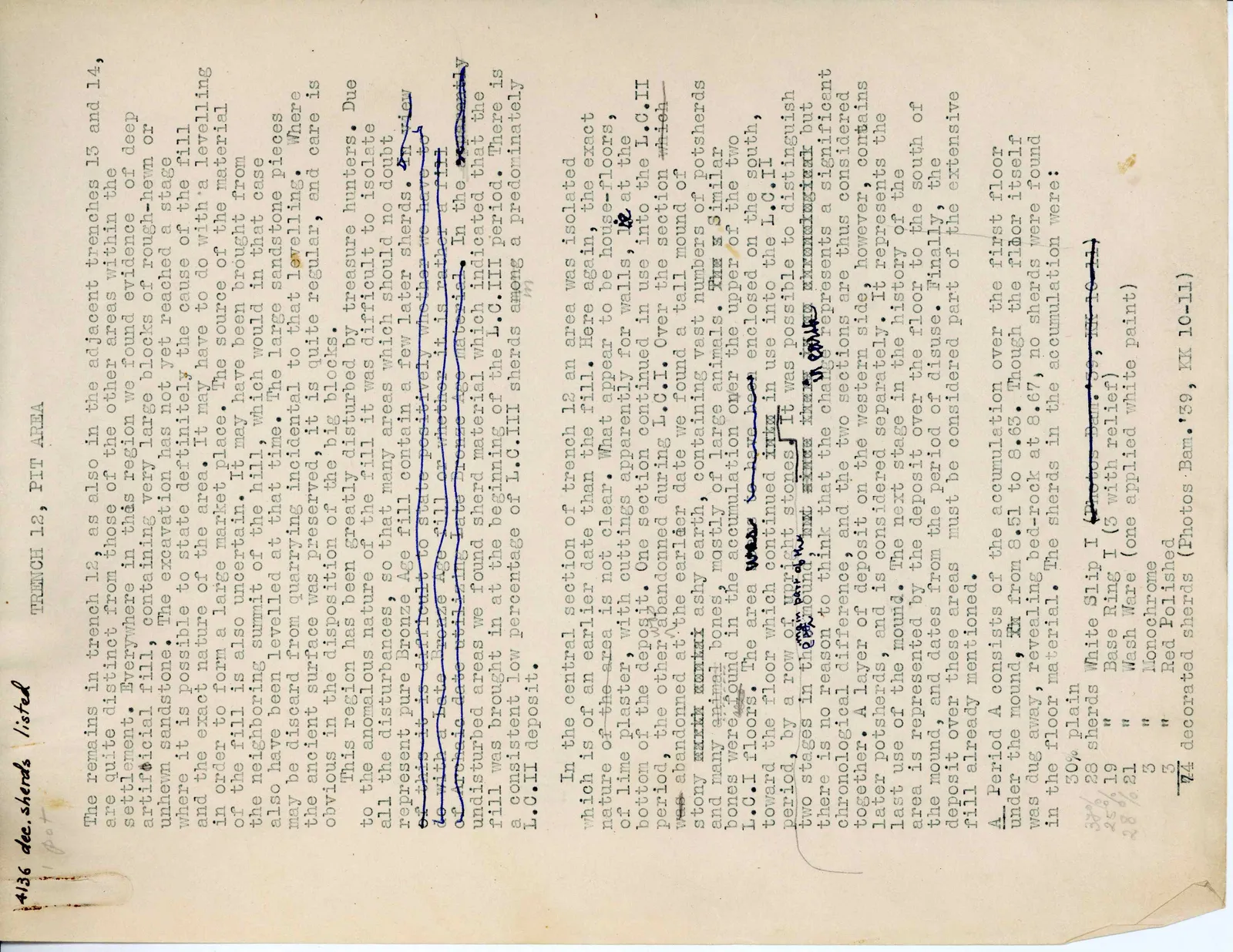
The remains in trench 12, as also in the adjacent trenches 13 and 14, are quite distinct from those of the other areas within the settlement. Everywhere in this region we found evidence of deep artificial fill, containing very large blocks of rough-hewn or unhewn sandstone. The excavation has not yet reached a stage where it is possible to state definitely the cause of the fill and the exact nature of the area. It may have to do with a large market place. The source of the material in order to form a large levelling. The large sandstone pieces of the fill is also uncertain. It may have been brought from the neighboring summit of the hill, which would in that case also have been levelled at that time. Where may be discard from quarrying incidental to that levelling. Where the ancient surface was preserved, it is quite regular, and care is obvious in the disposition of the big blocks.
This region has been greatly disturbed by treasure hunters. Due to the anomalous nature of the fill it was difficult to isolate all the disturbances, so that many areas which should no doubt represent pure Bronze Age fill contain a few later sherds. In view of this it is difficult to state positively whether we have to with a late Bronze Age fill or whether it is rather a fill of a Bronze Age late material. In the undisturbed areas we found sherd material which indicated that the fill was brought in at the beginning of the L.C.III period. There is a consistent low percentage of L.C.III sherds among a predominately L.C.II deposit.
In the central section of trench 12 an area was isolated which is of an earlier date than the fill. Here again, the exact nature of the area is not clear. What appear to be house-floors, of lime plaster, with cuttings apparently for walls, lie at the bottom of the deposit. One section continued in use into the L.C.II period, the other abandoned during L.C.I. Over the section which was abandoned at the earlier date we found a tall mound of stony earth, containing vast numbers of potsherds and many animal bones, mostly of large animals. The Similar bones were found in the accumulation over the upper of the two L.C.I floors. The area toward the floor which continued in use into the L.C.II period, by a row of upright stones. It was possible to distinguish two stages in the mound, and the two sections are thus considered together. A layer of deposit on the western side, however, contains later potsherds, and is considered separately. It represents the last use of the mound. The next stage in the history of the area is represented by the deposit over the floor to the south of the mound, and dates from the period of disuse. Finally, the deposit over these areas must be considered part of the extensive fill already mentioned.
A Period A consists of the accumulation over the first floor under the mound, from 8.51 to 8.65. Though the floor itself was dug away, revealing bed-rock at 8.67, no sherds were found in the floor material. The sherds in the accumulation were:
50% plain 28 sherds White Slip I (Photos Bam. '59, KK 10-11) 19 Base Ring I (5 with relief) 21 Wash Ware (one applied white paint) 5 Monochrome 3 Red Polished 74 decorated sherds (Photos Bam. '59, KK 10-11)
65 figures hard to readstruck struck outadded written in above” jug ditto, and what it repeatsword reading not certain