
Unnumbered pageScan 14 of 15
TRENCH 16
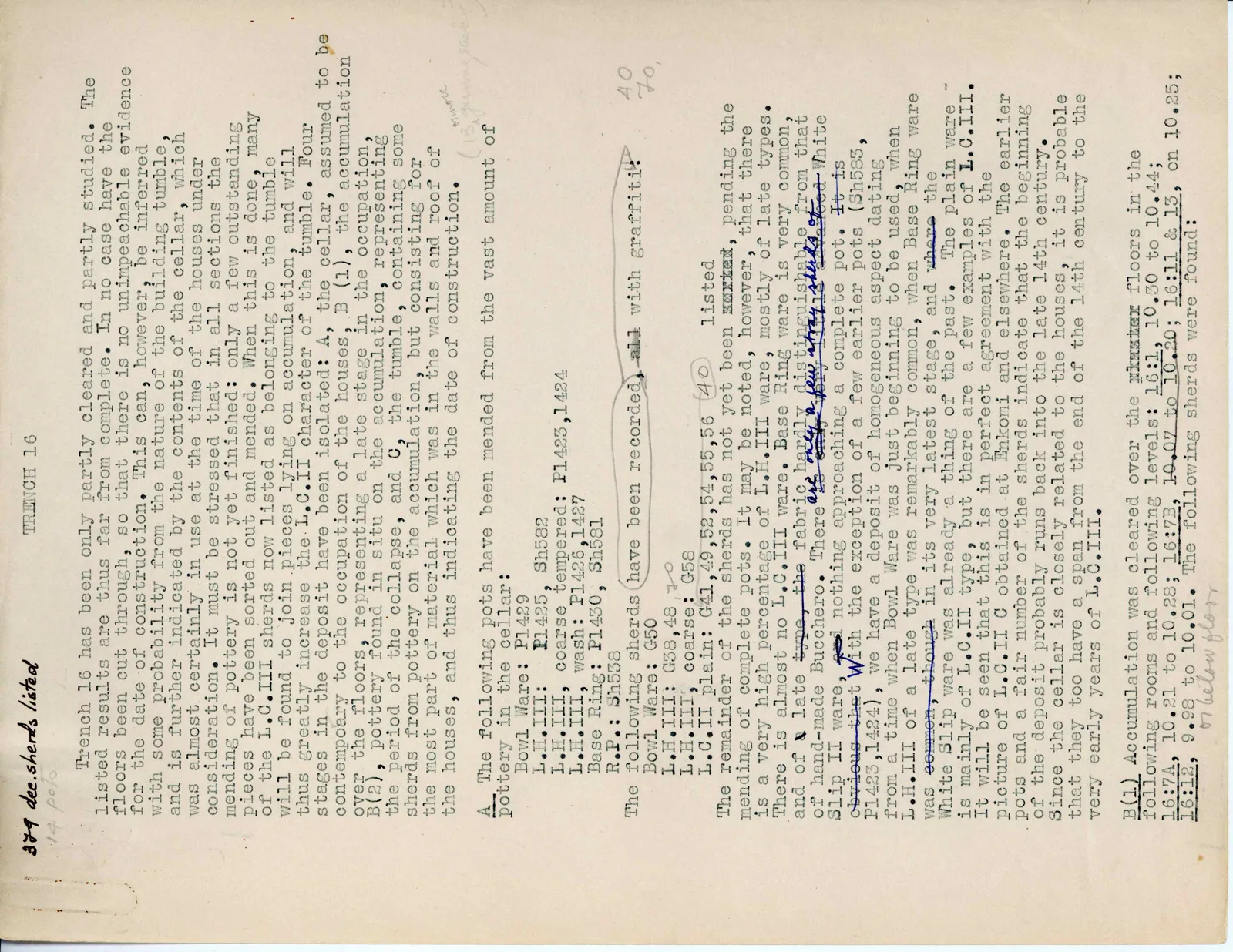
Trench 16 has been only partly cleared and partly studied. The listed results are thus far from complete. In no case have the floors been cut through, so that there is no unimpeachable evidence for the date of construction. This can, however, be inferred with some probability from the nature of the building tumble, and is further indicated by the contents of the cellar, which was almost certainly in use at the time of the houses under consideration. It must be stressed that in all sections the mending of pottery is not yet finished: only a few outstanding pieces have been sorted out and mended. When this is done, many of the L.C.III sherds now listed as belonging to the tumble will be found to join pieces lying on accumulation, and will thus greatly increase the deposit have been isolated: A, the cellar, assumed to be contemporary to the occupation of the houses, B (1), the accumulation over the floors, representing a late stage in the occupation, B(2), pottery found in situ on the collapse, and C, the tumble, containing some sherds from pottery on the accumulation, but consisting for the most part of material which was in the walls and roof of the houses, and thus indicating the date of construction.
A The following pots have been mended from the vast amount of pottery in the cellar: Bowl Ware: P1429 L.H.III: Sh582 L.H.III: P1425, tempered: P1423,1424 L.H.III, coarse: P1426,1427 L.H.III, wash: P1430, Sh581 Base Ring: P1450, Sh553 R.P.: Sh558
The following sherds Bowl Ware: G50 L.H.III: G58,48 L.H.III: G41,49,52,54,55,56 L.C.II plain: G58
The remainder of the sherds has not yet been mended, pending the listed numbers, however, that there is a very high percentage of complete pots. It may be noted, however, that there is almost no L.C.III ware. Base Ring ware is very common, and of a late type, the fabric hardly distinguishable from that of hand-made Bucchero. There are very few examples of White Slip II ware, and nothing approaching a complete pot. It is curious that with the exception of a few earlier pots (Sh583, P1423,1424), we have a deposit of homogeneous aspect dating from a time when Bowl Ware was remarkably common, when Base Ring ware was common, though in its very latest stage, and where the White Slip ware was already a thing of the past. The plain ware is mainly of L.C.II type, but there are a few examples of L.C.III. It will be seen that this is in perfect agreement with the picture of L.C.II C obtained at Enkomi and elsewhere. The earlier pots and a fair number of the sherds runs back into the late 14th century. Since the cellar is closely related to the houses, it is probable that they too have a span from the end of the 14th century to the very early years of L.C.III.
B(1) Accumulation was cleared over the upper floors in the following rooms and following levels: 16:1, 10.50 to 10.44; 16:7A, 10.21 to 10.28; 16:7B, 10.07 to 10.20; 16:11 & 13, on 10.25; 16:12, 9.98 to 10.01. The following sherds were found:
65 figures hard to readstruck struck outadded written in above” jug ditto, and what it repeatsword reading not certain