
Unnumbered pageScan 26 of 31
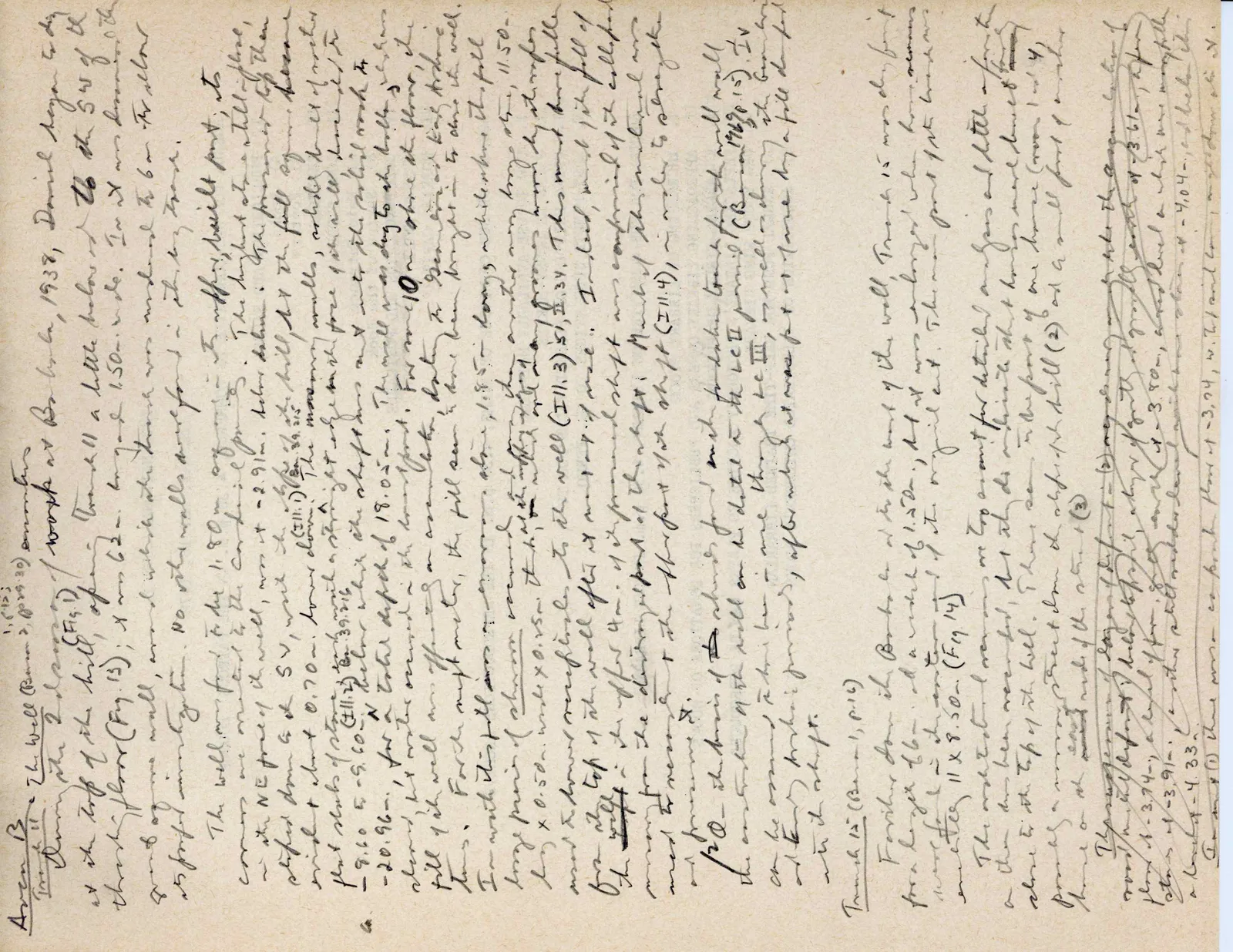
Area B Trench 11 The Well (Benson 2, p. 29.30) 1, p. 12 (drawing) annotations During the 2 season 1938 of work at B., by B., 1938, Daniel began to dig at the top of the hill, (Fig. 1) Open through a all a little hole NW to SE to the SW of the threshing floor (Fig. 13); 4 m 62 m long and 1.50m. wide. In it was discovered the S wall of one wall, around which the trench was widened to 6 m. to follow its perfect investigation. No other walls were found in its territory.
The well was found to the 1.80 m. of the S.-W E masonry built part, its corners were oriented to the cardinal points. The highest stone still in place, in the NE face of the well, was at -2.91 m. below datum. The pavement of the enclosure lies at -2.71 m. In the SW - NE section of the enclosure [illegible] the pavement drops sloped down to the SV, work to the b. f. the hill, but at the full square becomes flat, about 0.70 m. lower down. (II.1) Bo. 39.215 The masonry walls, a hole 1 wall of well laid blocks of stone \laid with a straight edge on its W face & an well smoothed/ to -8.60 E -9.60- (II.2) Bo. 39.216 N below which the shaft was cut into the perbol rock to -20.96-, for a total depth of 18.05 m. The well was dug to its bottom & it was cleared, but water occurred in the lowest part. For ca. 10 m. above its floor, the fill of the well was of an asre- late date, dating to the Geometrical and Archaic times. Further crept water, the fill seen to have been brought in to choke the well. In with this fill was a cranium, at ca. 1.85 m. down, while before this fell large pieces of stone, a carved architrave and another very large stone, 11.50- long x 0.50 m. wide x 0.25 m. thick, with carved moldings and many grooves worn by its ropes, used to drain receptacles to the well (II.3) 51, II. 34. This must have fallen from the top of the wall, after its most part of it was . In dead, most of its collapse falls in the upper 4 m. of its perma-ed shaft are comprised of its collapsed masonry from the chidron part of the shaft; Marest of the material was used to raise a t the top of the shaft (II.4), in order to elevate the well around it.
12 O- the basis of the sherds found and in its fashion to unity its well wall the construction of the well can be dated to the LC II period (CBenson 1969 p 15) IV can be assumed to have been in use through LC III; as well as during the Geometric and Early Archaic periods, after which it was put out of use by a fill dumped into its shaft.
Trench 15 (Benson 1, p. 16)
Further down its Bantoulas to the its west of the well, Trench 15 was dug, first for a length 16 m. and a width of 1.50 m., but it was enlarged, when become necessary for the examination of its original cut. The new part of the trench was another 11 x 8.50 m. (Fig 14)
The architectural remains were too scanty for detailed analyses and better conformaas they have been excavated, but they do indicate that houses were built close to the top of the well. There was the front of one house (room 1 and 4), possibly a narrow street down the slope of the hill (2) and a small part of another house on its east side of the street (3)
~~The succession of layers in room 4 is :- (3) mixed debris like the upper layer of room 1; in it deposits of fallen bits of white wall plaster; at level of -3.61 m, a floor floor at -3.74-, a level of fine, crushed white plaster fragments; a level a bit more complicated, -3.91-, another level with white plaster fragments at -4.04-, and bedrock at a level of -4.33 m. In room 4 (1) three more or less patchy floors at -3.74, w. fr./ and low [illegible] plaster at/~~
65 figures hard to readstruck struck outadded written in above” jug ditto, and what it repeatsword reading not certain