
Unnumbered pageScan 5 of 10
-5-
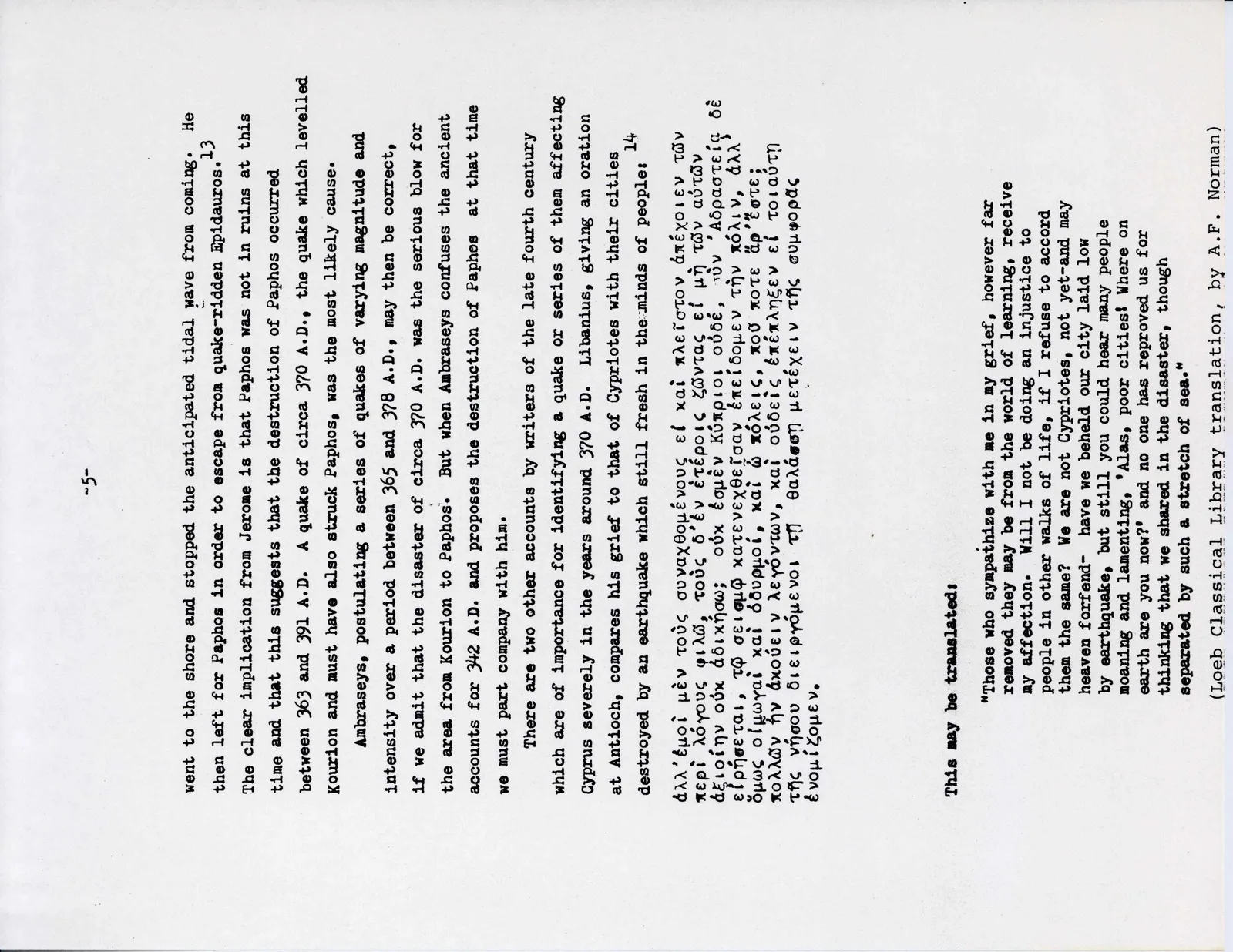
went to the shore and stopped the anticipated tidal wave from coming. He then left for Paphos in order to escape from quake-ridden Epidauros.13 The clear implication from Jerome is that Paphos was not in ruins at this time and that this suggests that the destruction of Paphos occurred between 363 and 391 A.D. A quake of circa 370 A.D. the quake which levelled Kourion and must have also struck Paphos, was the most likely cause. Ambraseys, postulating a series of quakes of varying magnitude and intensity over a period between 365 and 378 A.D., may then be correct, if we admit that the disaster of circa 370 A.D. was the serious blow for the area from Kourion to Paphos. But when Ambraseys confuses the ancient accounts for 342 A.D. and proposes the destruction of Paphos at that time we must part company with him. There are two other accounts by writers of the late fourth century which are of importance for identifying a quake or series of them affecting Cyprus severely in the years around 370 A.D. Libanius, giving an oration at Antioch, compares his grief to that of Cypriotes with their cities destroyed by an earthquake which still fresh in the minds of people:14
Greek text, Libanius, Oration XI
This may be translated:
"Those who sympathize with me in my grief, however far removed they may be from the world of learning, receive my affection. Will I not be doing an injustice to people in other walks of life, if I refuse to accord them the same? We are not Cypriotes, not yet-and may heaven forfend- have we beheld our city laid low by earthquake, but still you could hear many people moaning and lamenting, 'Alas, poor cities! Where on earth are you now?' and no one has reproved us for thinking that we shared in the disaster, though separated by such a stretch of sea."
(Loeb Classical Library translation, by A.F. Norman)
65 figures hard to readstruck struck outadded written in above” jug ditto, and what it repeatsword reading not certain