
Page 3Scan 34 of 54
-3-
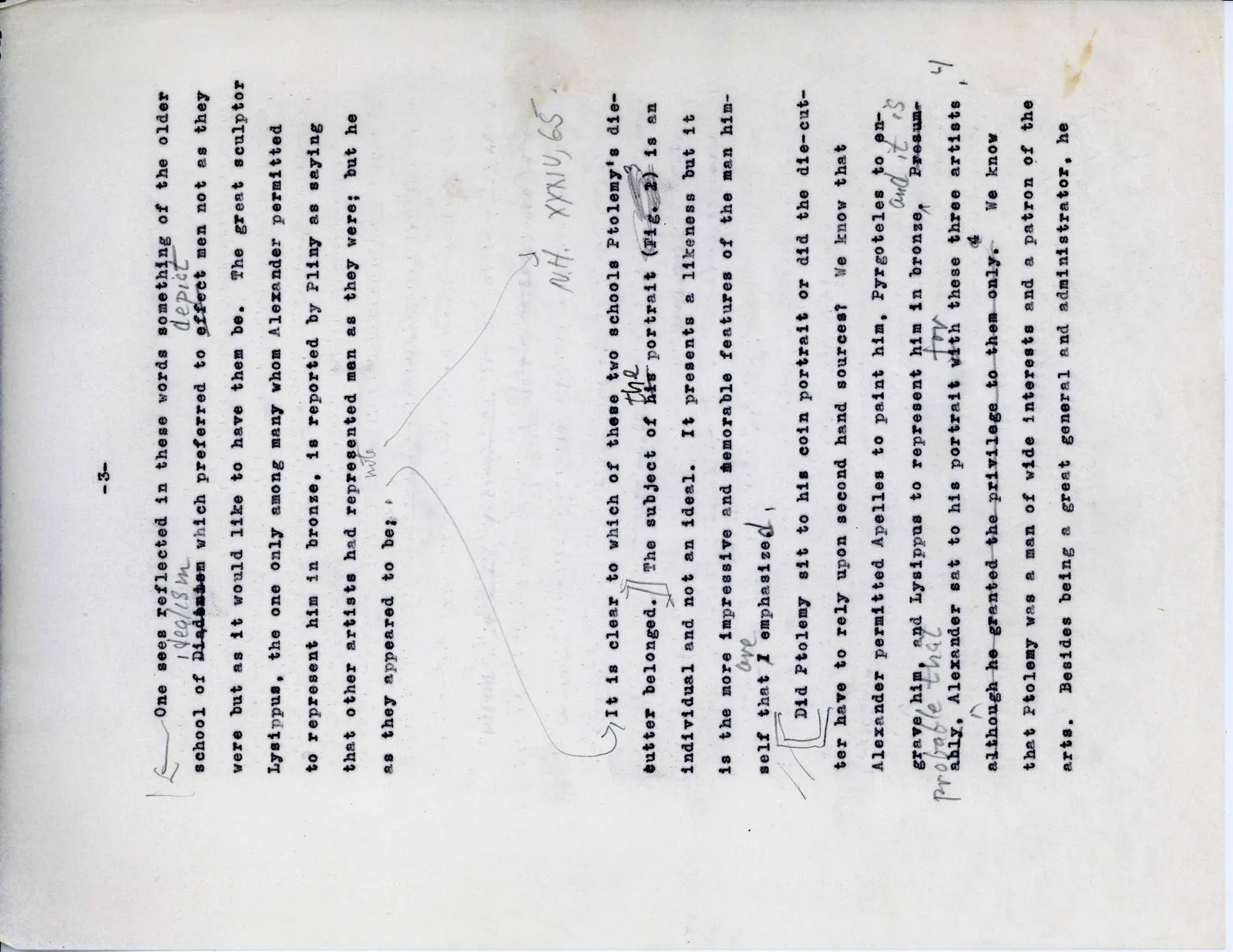
One sees reflected in these words something of the older school of [handwritten: idealism] which preferred to [handwritten: depict] effect men not as they were but as it would like to have them be. The great sculptor Lysippus, the one only among many whom Alexander permitted to represent him in bronze, is reported by Pliny as saying that other artists had represented men as they were; but he as they appeared to be. [handwritten: wte]
It is clear to which of these two schools Ptolemy's diecutter belonged. [handwritten: the] The subject of [handwritten: his] portrait (fig. 2) is an individual and not an ideal. It presents a likeness but it is the more impressive and memorable features of the man himself that I emphasized. [handwritten: ave]
Did Ptolemy sit to his coin portrait or did the die-cutter have to rely upon second hand sources? We know that Alexander permitted Apelles to paint him. Pyrgoteles to engrave him, and Lysippus to represent him in bronze. [handwritten: and] [handwritten: Presumably] [handwritten: Probable that] Alexander sat to his portrait with these three artists, [handwritten: 4] although he granted the privilege to them only. [handwritten: 4] We know that Ptolemy was a man of wide interests and a patron of the arts. Besides being a great general and administrator, he
Handwritten: XXXIV, 65 / N.H.
65 figures hard to readstruck struck outadded written in above” jug ditto, and what it repeatsword reading not certain