
Unnumbered pageScan 23 of 28
Continued from scan 22
… archedogia recent Monroy - Egyptian reg. Diocletian epochcolumn-
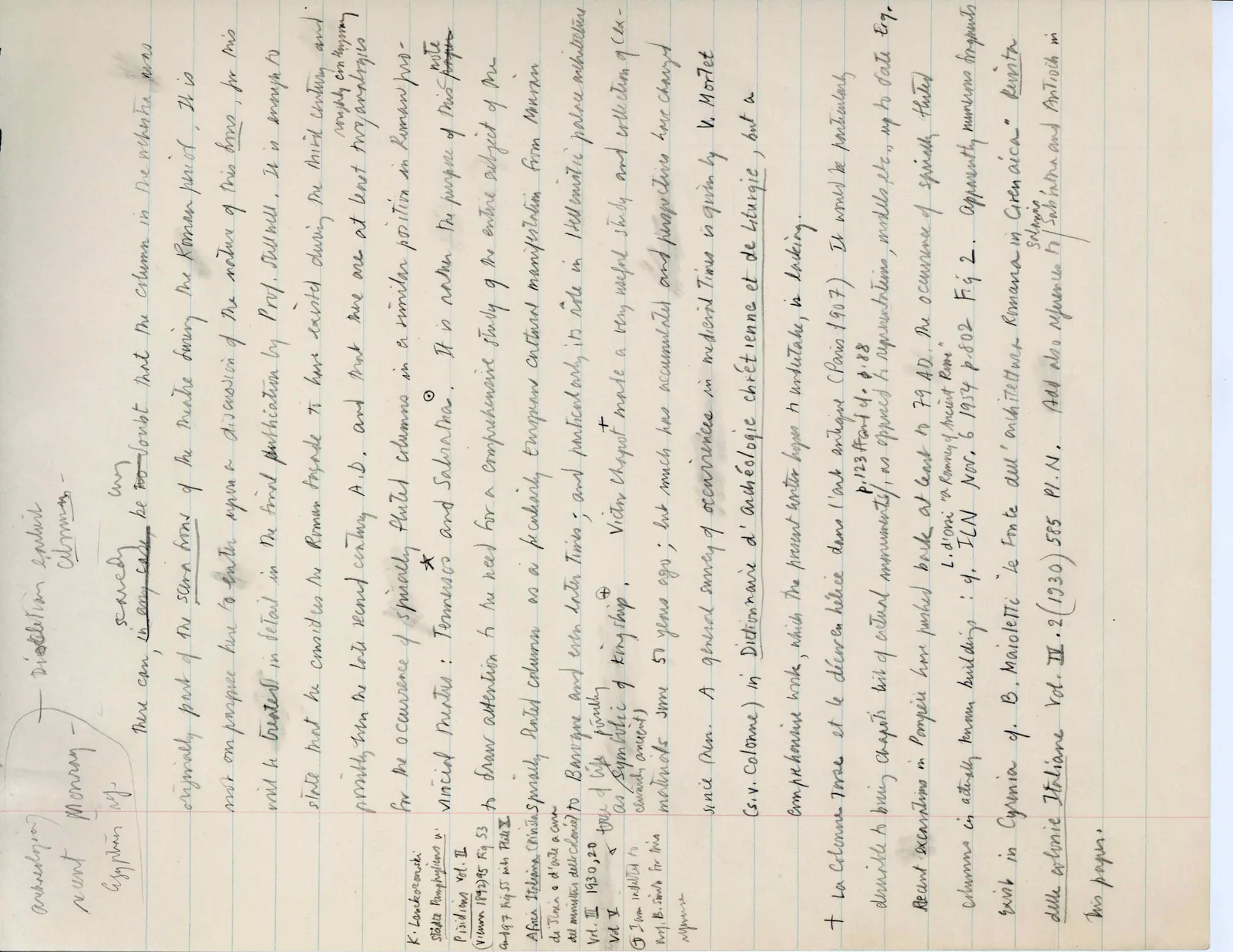
there can, scarcely in any case, be no any doubt that the column in the narthex was originally part of the scaena frons of the theatre during the Roman period. It is not our purpose here to enter upon a discussion of the nature of this scaena, for this will be treated in detail in the final publication by Prof. Stillwell. It is enough to state that he considers the Roman façade to have existed during the third century and possibly even the late second century A.D. and that roughly contemporary there are at least two archetypes for the occurrence of spirally fluted columns in a similar position in Roman provincial theatres: Termessos and Sabratha⊙. It is rather the purpose of this note paper to draw attention to the need for a comprehensive study of the entire subject of the column as a peculiarly European cultural manifestation from Minoan times to Baroque and even later times; and particularly its role in Hellenistic palace architecture and as symbolic of kingship, [inserted: +] (tree of life firmly cleared, ancient)
Victor Chapot made a very useful study and collection of materials some 50 years ago; but much has accumulated and perspectives have changed since then. A general survey of occurrences in medieval times is given by V. Mortet (s.v. Colonne) in Dictionnaire d'archéologie chrétienne et de liturgie, but a comprehensive work, which the present writer hopes to undertake, is lacking.
+ La Colonne torse et le décor en hélice dans l'art antique (Paris 1907) It would be particularly desirable to bring Chapot's list of actual monumentsp. 123 ff and 4. p.88/, as opposed to representations, models etc., up to date. E.g. Recent excavations in Pompeii have pushed back at least to 79 A.D. the occurrence of spirally fluted columns in actually known buildings: cf. L. d'Orsi "A Recovery of Ancient Rome" ILN Nov. 6 1954 p. 802 Fig 2. Apparently numerous fragments exist in Cyrenaica cf. B. Maioletti "Le Fonte dell' architettura Romana in Ciren aica" Solonio Revista delle Colonie Italiane Vol. IV IV .2 (1930) 585 Pl. N. Add also references to Sabratna and Antioch in this paper.
[margin left: K. Lanckoronski Städte Pamphyliens u. Pisidiens Vol. II (Vienna 1892) 95 Fig. 53 and p. 97 Fig 55 with Plate II
Africa Italiana, Crinista Spunally fluted di Storia e d'arte a cura del ministero delle colonie to Vol. I III 1930, 20 Vol V ⊙ I am indebted to Prof. B. Suida for this reference]
65 figures hard to readstruck struck outadded written in above” jug ditto, and what it repeatsword reading not certain