
Unnumbered pageScan 31 of 67
#298 31
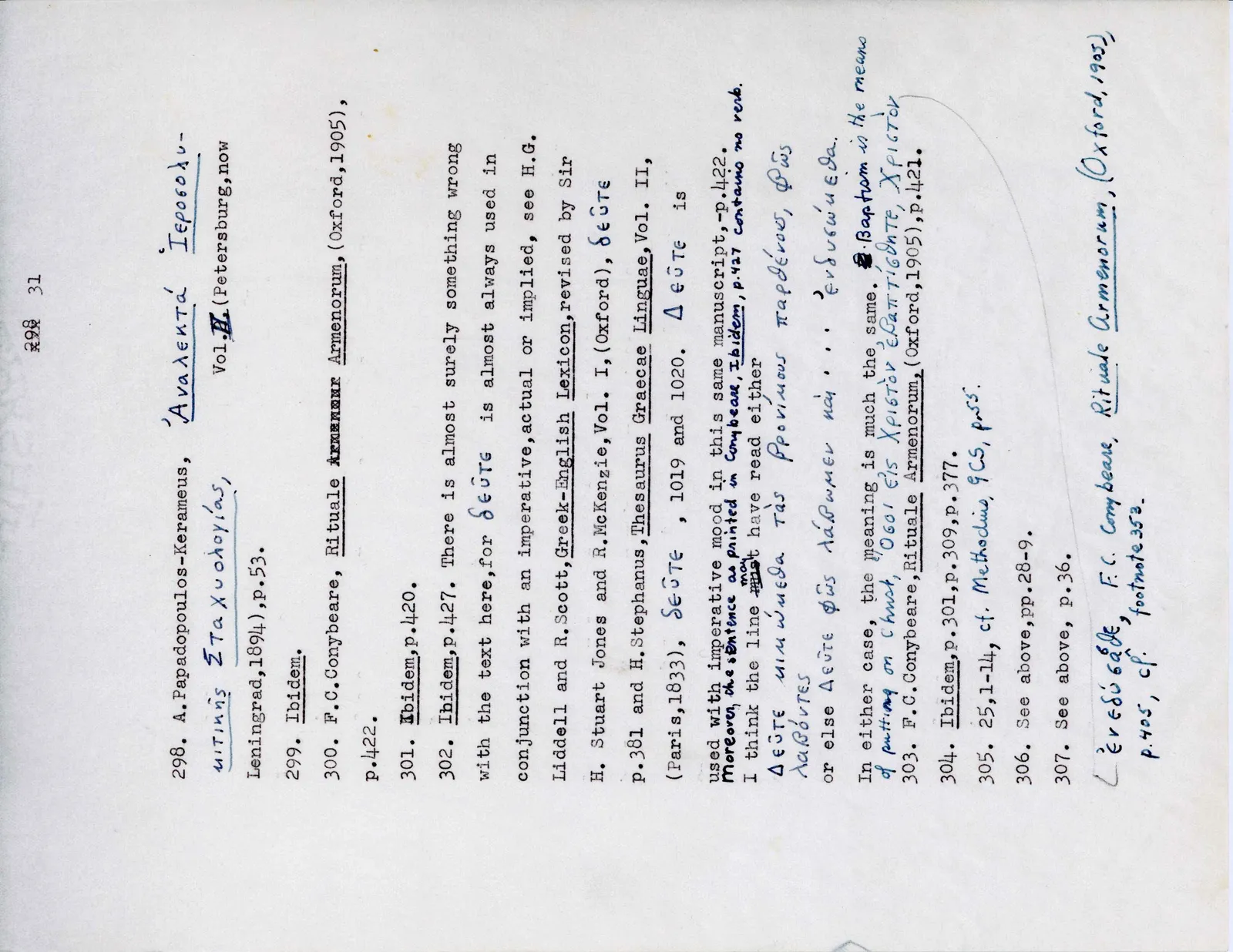
298. A.Papadopoulos-Kerameus, [handwritten: 'Αναλεκτα Ιεροσολυ-] [handwritten: μιτικης Σταχυολογιας,] Vol. [handwritten: II.] (Petersburg,now Leningrad,1894),p.53. 299. Ibidem. 300. F.C.Conybeare, Rituale Armenorum, (Oxford,1905), p.422. 301. Ibidem,p.420. 302. Ibidem,p.427. There is almost surely something wrong with the text here,for δεῦτε is almost always used in conjunction with an imperative,actual or implied, see H.G. Liddell and R.Scott,Greek-English Lexicon,revised by Sir H. Stuart Jones and R.McKenzie,Vol. I,(Oxford), δεῦτε p.381 and H.Stephanus,Thesaurus Graecae Linguae,Vol. II, (Paris,1833), δεῦτε , 1019 and 1020. Δεῦτε is used with imperative mood in this same manuscript,-p.422. Moreover, the sentence as printed in Conybeare, Ibidem, p.427 contains no verb. I think the line [handwritten: may] must have read either Δεῦτε [handwritten: ἀναωνωσ?]μεν [handwritten: ?] ... [handwritten: ἐνδυσώμεθα] λαβόντες [handwritten: τας προφήνους φῶς] or else Δεῦτε φῶς λάβωμεν ... ἐνδυσώμεθα. In either case, the meaning is much the same. [handwritten: 2. Baptism is the means of putting on Christ, ὅσοι εἰς Χριστὸν ἐβαπτίσθητε, Χριστὸν] 303. F.C.Conybeare,Rituale Armenorum,(Oxford,1905),p.421. 304. Ibidem,p.301,p.309,p.377. 305. 25,1-14, cf. Methodius, GCS, p.55. 306. See above,pp.28-9. 307. See above, p.36. [handwritten: Ἐνεδύσασθε, F.C. Conybeare, Rituale Armenorum, (Oxford,1905), p.405, cf. footnote 353.]
65 figures hard to readstruck struck outadded written in above” jug ditto, and what it repeatsword reading not certain