
Unnumbered pageScan 2 of 67
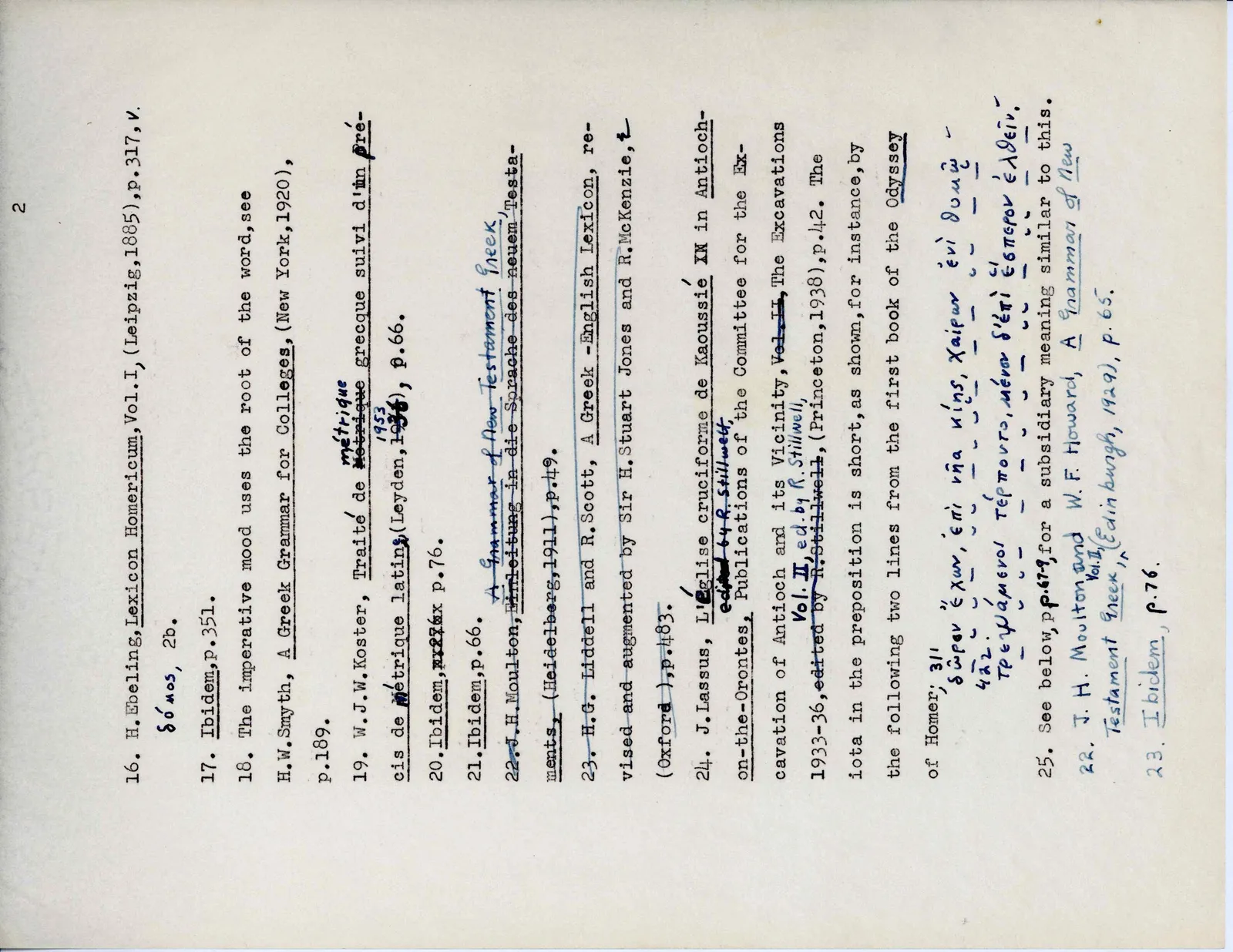
16. H.Ebeling, Lexicon Homericum, Vol.I, (Leipzig,1885), p.317, v. δό'μος, 2b. 17. Ibidem, p.351. 18. The imperative mood uses the root of the word, see H.W.Smyth, A Greek Grammar for Colleges, (New York,1920), p.189. 19. W.J.W.Koster, Traité de [handwritten: métrique] grecque suivi d'un précis de métrique latine (Leyden,1953), p.66. 20. Ibidem, p.76. 21. Ibidem, p.66. 22. J.H.Moulton, [handwritten: A Grammar of New Testament Greek], Einleitung in die Sprache des neuen Testaments, (Heidelberg,1911), p.49. 23. H.G. Liddell and R.Scott, A Greek-English Lexicon, revised and augmented by Sir H.Stuart Jones and R.McKenzie, [handwritten: ‡] (Oxford), p.483. 24. J.Lassus, L'Eglise cruciforme de Kaoussie [handwritten: XII] in Antiochon-the-Orontes, Publications of the Committee for the Excavation of Antioch and its Vicinity, [handwritten: Vol. II, ed.by R.Stillwell], The Excavations 1933-36, [handwritten: edited by R.Stillwell], (Princeton,1938), p.42. The iota in the preposition is short, as shown, for instance, by the following two lines from the first book of the Odyssey of Homer; [handwritten: 311 ξ̔ξπαν ἐν χων, ἐπὶ νῆα κίης, χαίρων ἐν δόμω; 422. τρεψάμενος, πέναν δ' ἐπὶ ἑ̔ξπέρου ἐλθεῖν.] 25. See below, pp.67-9, for a subsidiary meaning similar to this. 22. J.H.Moulton and W.F.Howard, [handwritten: Vol. II,] A Grammar of New Testament Greek, (Edinburgh,1929), p.65. 23. Ibidem, p.76.
65 figures hard to readstruck struck outadded written in above” jug ditto, and what it repeatsword reading not certain