
Unnumbered pageScan 70 of 97
69
meaning. Those who had [handwritten: been?] just been baptized were anointed with myrrh that they might [handwritten: ?] spread abroad the perfume of Christianity, the [handwritten: εὐωδία] of the Epistle to the [handwritten: Ephesians.] [handwritten: 470]
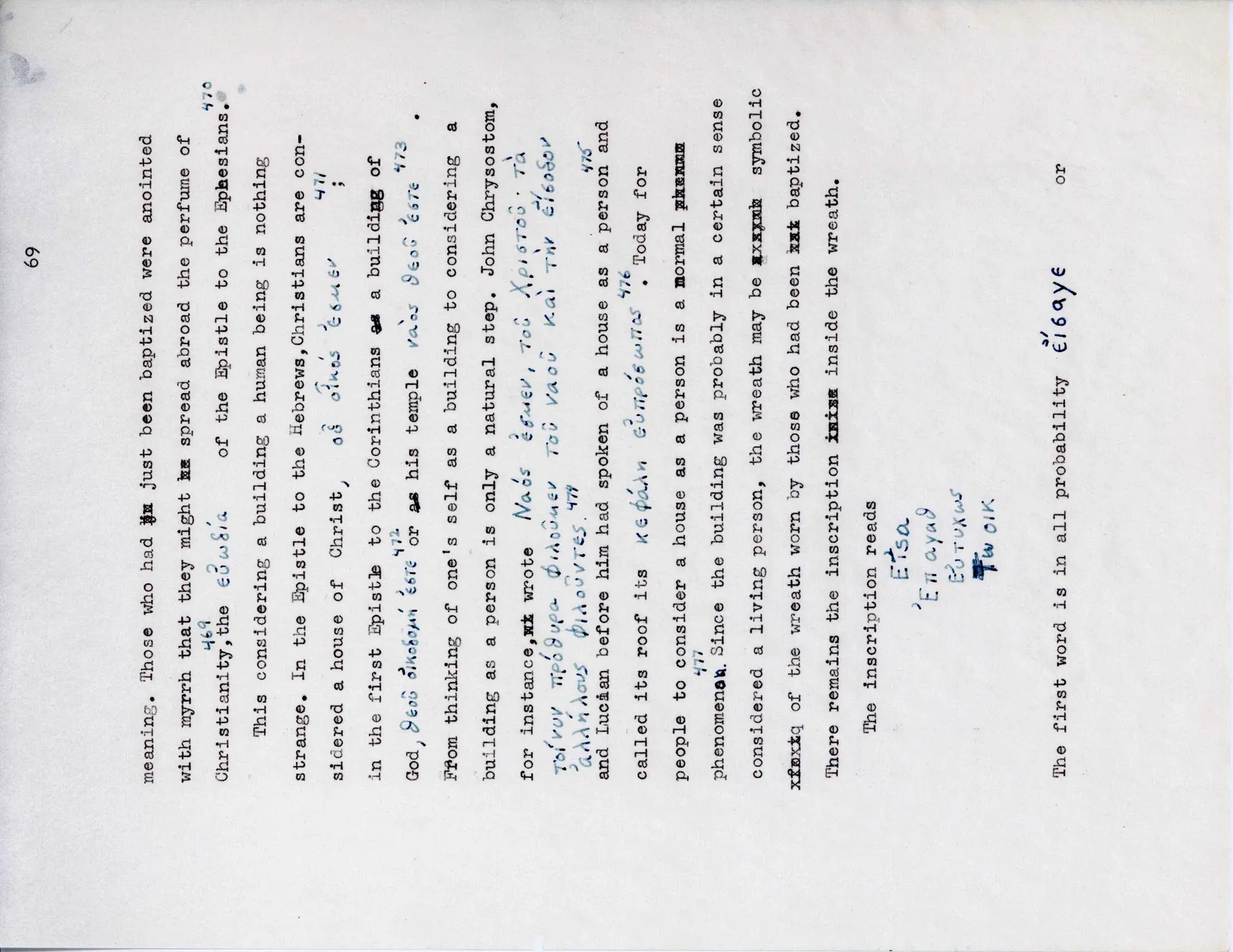
This considering a building a human being is nothing strange. In the Epistle to the Hebrews, Christians are considered a house of Christ, [handwritten: οἱ οἶκος ἐσμεν] [handwritten: 471] in the first Epistle to the Corinthians as a building of God, [handwritten: θεοῦ οἰκοδομὴ ἐστε] [handwritten: 472] or as his temple [handwritten: ναὸς θεοῦ ἐστε] [handwritten: 473]. From thinking of one's self as a building to considering a building as a person is only a natural step. John Chrysostom, for instance, [handwritten: ?] wrote [handwritten: Ναὸς ἐσμεν, τοῦ Χριστοῦ· τὰ τοίνυν προθύρα φιλοῦμεν καὶ τὸν ναὸν φιλοῦντες] [handwritten: 474] and Lucian before him had spoken of a house as a person and called its roof its [handwritten: κεφαλὴν ἐμπρόσωπος] [handwritten: 476]. Today for people to consider a house as a person is a normal phenomenon. [handwritten: 477] Since the building was probably in a certain sense considered a living person, the wreath may be a symbolic of the wreath worn by those who had been baptized. There remains the inscription inside the wreath.
The inscription reads [handwritten: Εἰσα Επαγαθ Ευτυχως Τω οικ]
The first word is in all probability [handwritten: εἴσαγε] or
65 figures hard to readstruck struck outadded written in above” jug ditto, and what it repeatsword reading not certain