
Unnumbered pageScan 60 of 97
59
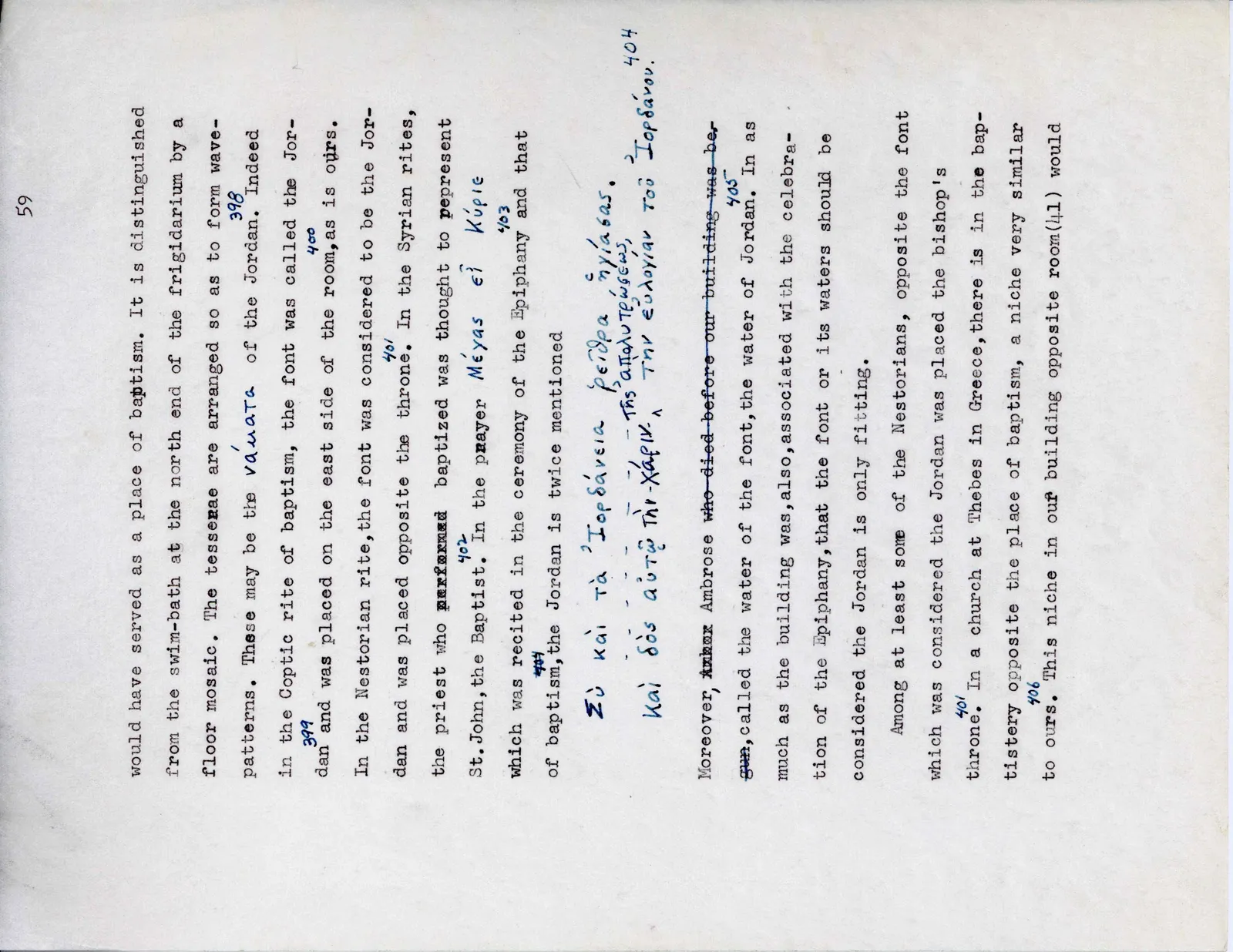
would have served as a place of baptism. It is distinguished from the swim-bath at the north end of the frigidarium by a floor mosaic. These tesserae are arranged so as to form wavepatterns. [handwritten: 398] These may be the [handwritten: ναματα] of the Jordan. Indeed in the Coptic rite of baptism, the font was called the Jordan [handwritten: 399] and was placed on the east side of the room, as is ours. In the Nestorian rite, the font was considered to be the Jordan and was placed opposite the throne. [handwritten: 401] In the Syrian rites, the priest who [handwritten: baptized] baptized was thought to represent St. John, the Baptist. [handwritten: 402] In the prayer [handwritten: Μέγας εἶ Κύριε] [handwritten: 403] which was recited in the ceremony of the Epiphany and that of baptism, the Jordan is twice mentioned [handwritten: 404]
[handwritten: Σὺ καὶ τὰ Ἰορδάνεια ῥεέθρα ηγίασας. — — — τῆς ἀπολυτρώσεως, Ἰορδάνον. καὶ δὸς αὐτῷ τὴν Χάριν, τὴν εὐλογίαν τοῦ Ἰορδάνου.]
Moreover, Ambrose who died before our building was be- [handwritten: 405] {strike: can}, called the water of the font, the water of Jordan. In as much as the building was, also, associated with the celebration of the Epiphany, that the font or its waters should be considered the Jordan is only fitting.
Among at least some of the Nestorians, opposite the font which was considered the Jordan was placed the bishop's throne. [handwritten: 407] In a church at Thebes in Greece, there is in the baptistery opposite the place of baptism, a niche very similar to ours. [handwritten: 406] This niche in our building opposite room (4l) would
65 figures hard to readstruck struck outadded written in above” jug ditto, and what it repeatsword reading not certain