
Page 57Scan 58 of 97
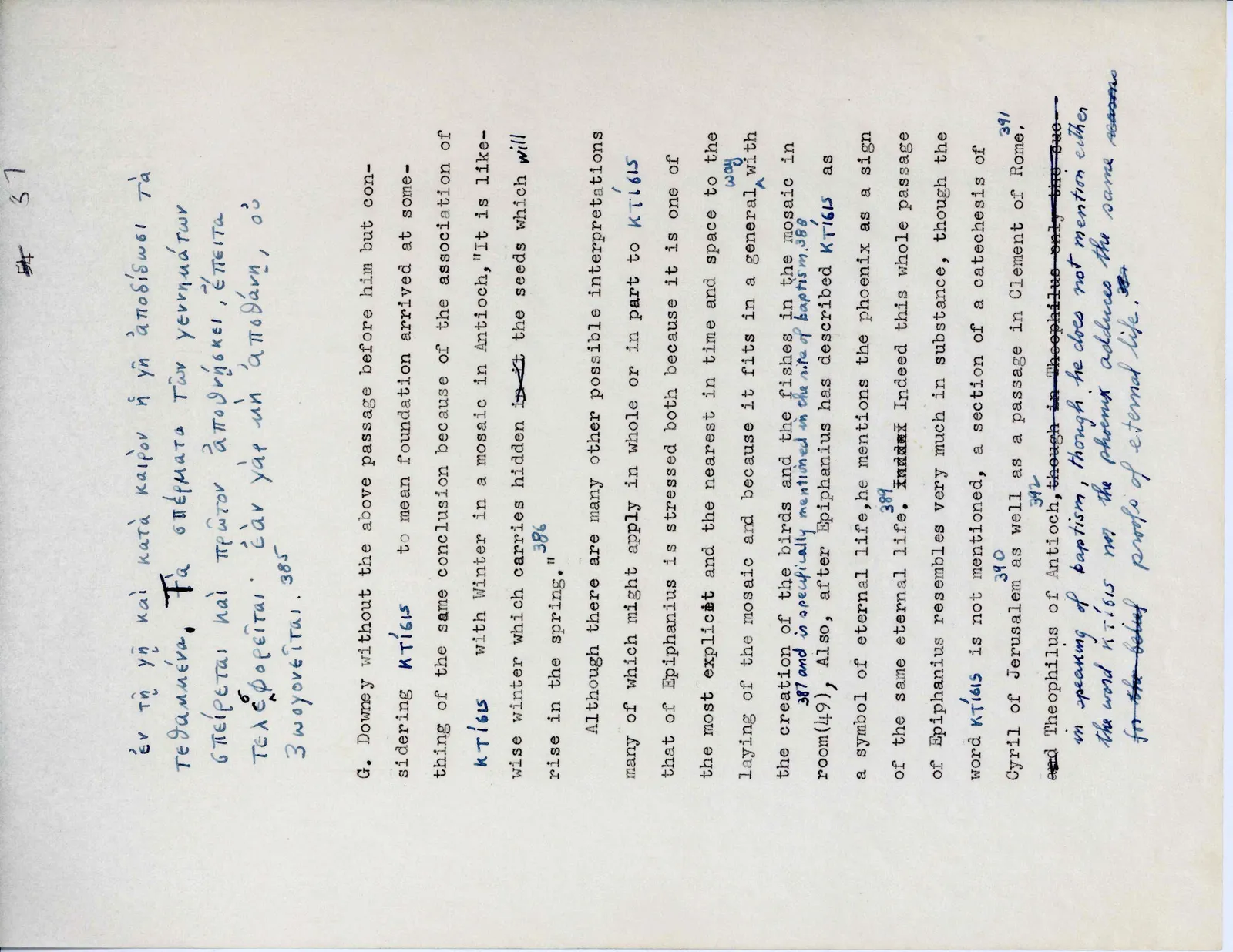
G. Downey without the above passage before him but considering [handwritten: KT1615] to mean foundation arrived at something of the same conclusion because of the association of [handwritten: KT1615] with Winter in a mosaic in Antioch, "It is likewise winter which carries hidden in [handwritten: it] the seeds which [handwritten: will] rise in the spring." [handwritten: 386]
Although there are many other possible interpretations many of which might apply in whole or in part to [handwritten: KT1615] that of Epiphanius is stressed both because it is one of the most explicit [handwritten: and] the nearest in time and space to the laying of the mosaic and because it fits in a general [handwritten: way] with the creation of the birds and the fishes in the mosaic in room (49), Also, after Epiphanius has described [handwritten: KT1615] as a symbol of eternal life, [handwritten: 389] he mentions the phoenix as a sign of the same eternal life. Indeed Indeed this whole passage of Epiphanius resembles very much in substance, though the word [handwritten: KT1615] is not mentioned, a section of a catechesis of Cyril of Jerusalem as well as a passage in Clement of Rome, [handwritten: 391] and Theophilus of Antioch, though [handwritten: 392] though in Theophilus only the Sue in speaking of baptism, though he does not mention either the word [handwritten: KT1615] nor the phoenix adduce the same reason for the being proofs of eternal life. [handwritten: 393]
Printed: 6 4 3 4 …
Stamp: 54
Handwritten: 385 at top right, Greek text: έν τῆ γῆ καὶ κατὰ καιρὸν ἡ γῆ ἀποδίδωσι τὰ τεθαμμένα. Τὰ σπέρματα τῶν γεννημάτων ἀποθνῄσκει, ἐπειτα ζωογονεῖται. ἐὰν γὰρ μὴ ἀποθάνῃ, οὐ ζωογονεῖται. 385
65 figures hard to readstruck struck outadded written in above” jug ditto, and what it repeatsword reading not certain