
Unnumbered pageScan 2 of 25
Continued from scan 1
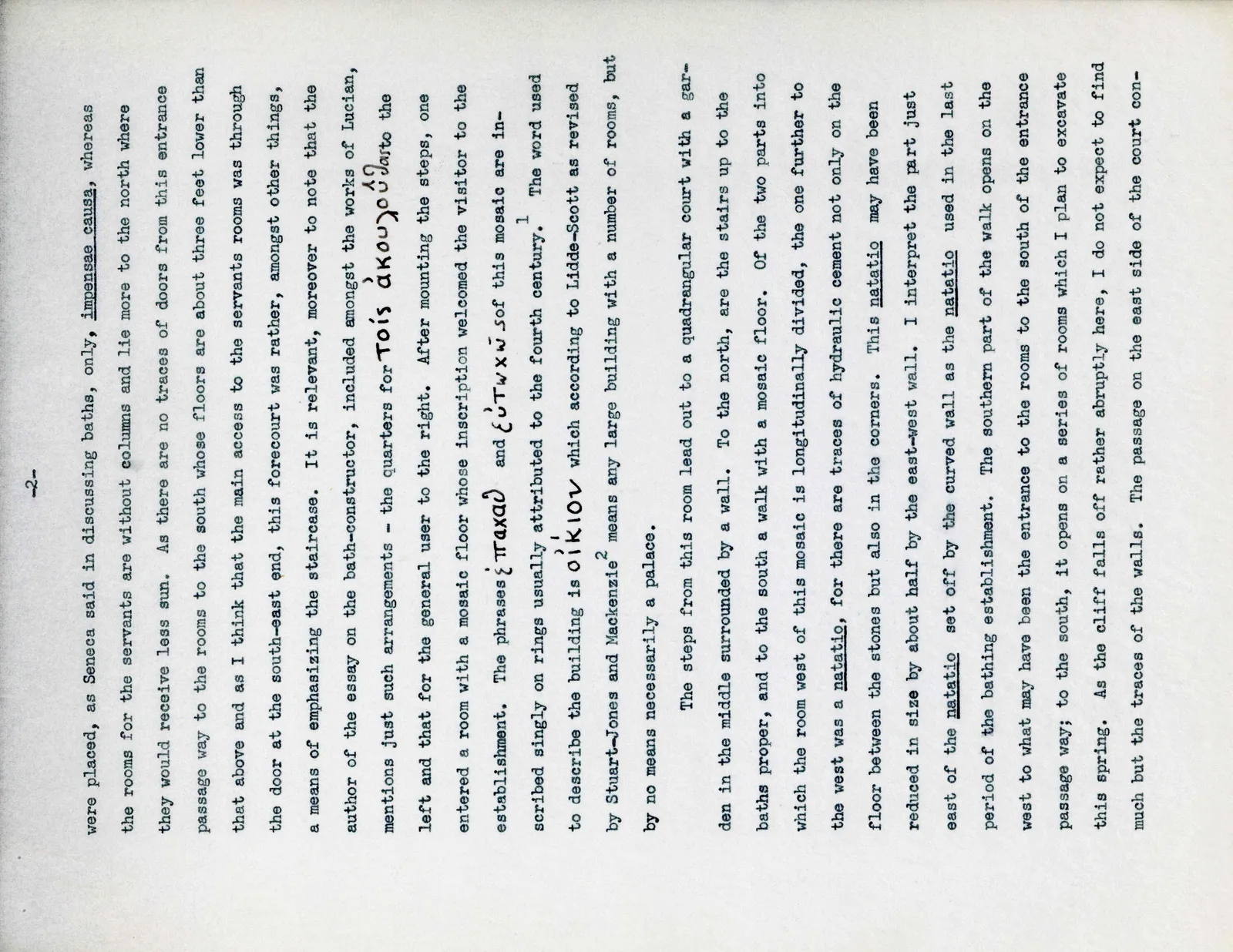
… were placed, as Seneca said in discussing baths, only, impensae causa, whereas the rooms for the servants are without columns and lie more to the north where they would receive less sun. As there are no traces of doors from this entrance passage way to the rooms to the south whose floors are about three feet lower than that above and as I think that the main access to the servants rooms was through the door at the south-east end, this forecourt was rather, amongst other things, a means of emphasizing the staircase. It is relevant, moreover to note that the author of the essay on the bath-constructor, included amongst the works of Lucian, mentions just such arrangements - the quarters for [handwritten: τοῖς ἀκουσταῖς] to the left and that for the general user to the right. After mounting the steps, one entered a room with a mosaic floor whose inscription welcomed the visitor to the establishment. The phrases [handwritten: ἑπταπλαυ] and [handwritten: εὐτυχῶς] of this mosaic are inscribed singly on rings usually attributed to the fourth century.[sup 1] The word used to describe the building is [handwritten: οἶκιον] which according to Lidde-Scott as revised by Stuart-Jones and Mackenzie[sup 2] means any large building with a number of rooms, but by no means necessarily a palace.
The steps from this room lead out to a quadrangular court with a garden in the middle surrounded by a wall. To the north, are the stairs up to the baths proper, and to the south a walk with a mosaic floor. Of the two parts into which the room west of this mosaic is longitudinally divided, the one further to the west was a natatio, for there are traces of hydraulic cement not only on the floor between the stones but also in the corners. This natatio may have been reduced in size by about half by the east-west wall. I interpret the part just east of the natatio set off by the curved wall as the natatio used in the last period of the bathing establishment. The southern part of the walk opens on the west to what may have been the entrance to the rooms to the south of the entrance passage way; to the south, it opens on a series of rooms which I plan to excavate this spring. As the cliff falls off rather abruptly here, I do not expect to find much but the traces of the walls. The passage on the east side of the court con- … continues
65 figures hard to readstruck struck outadded written in above” jug ditto, and what it repeatsword reading not certain