
Unnumbered pageScan 13 of 25
-2-
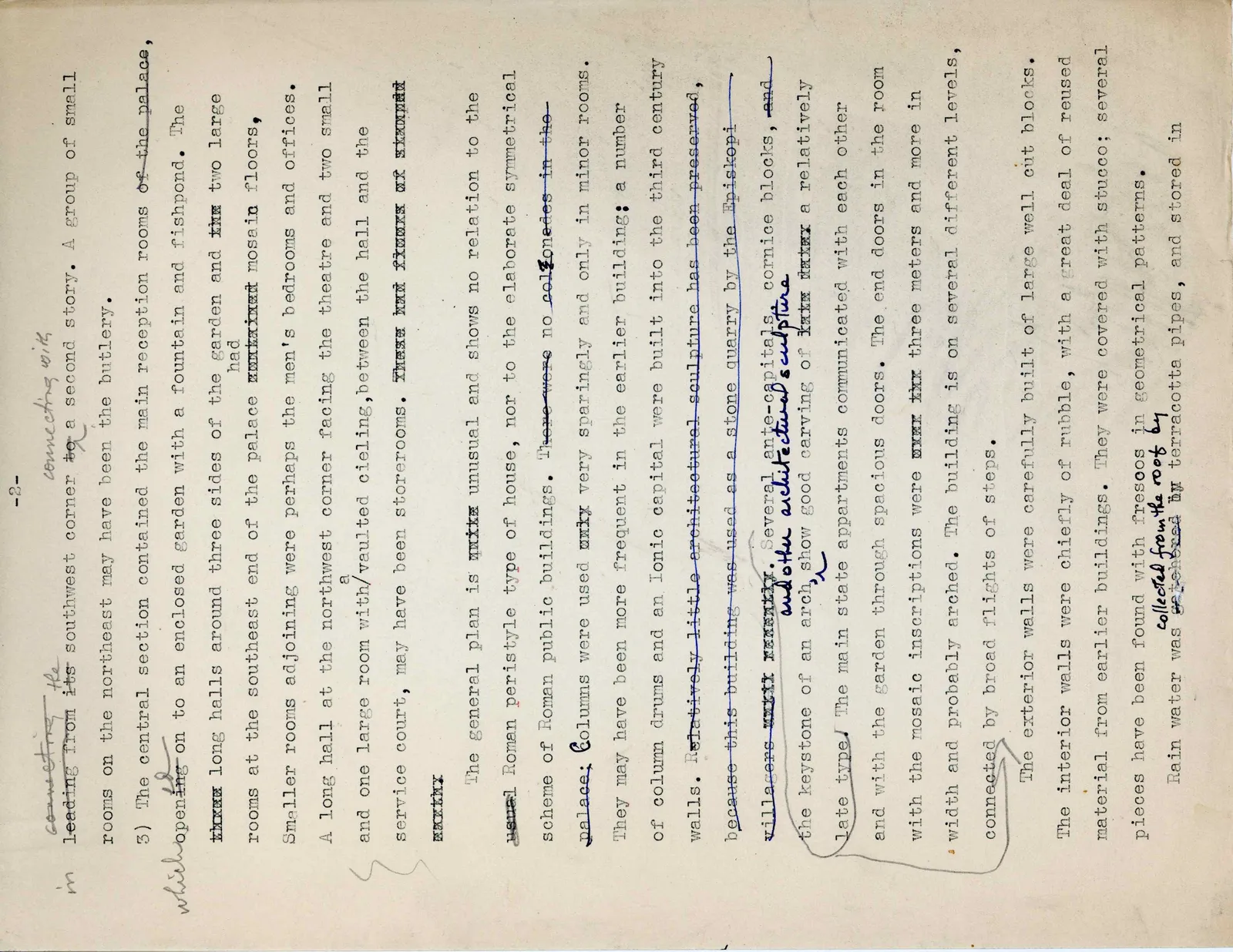
[handwritten: connecting] [handwritten: the] in leading from its southwest corner to a second story. A group of small rooms on the northeast may have been the butlery. 3) The central section contained the main reception rooms of the palace, [handwritten: connecting with] [handwritten: whilst] opening on to an enclosed garden with a fountain and fishpond. The two large long halls around three sides of the garden and two large rooms at the southeast end of the palace had mosaic floors. Smaller rooms adjoining were perhaps the men's bedrooms and offices. A long hall at the northwest corner facing the theatre and two small rooms between the hall and the [handwritten: a] and one large room with vaulted cieling, may have been storerooms. service court,
The general plan is unusual and shows no relation to the usual Roman peristyle type of house, nor to the elaborate symmetrical scheme of Roman public buildings. There were no colonades in the palace. Columns were used very sparingly and only in minor rooms. They may have been more frequent in the earlier building: a number of column drums and an Ionic capital were built into the third century walls. Relatively little architectural sculpture has been preserved, because this building was used as a stone quarry by the Episkopi villagers. Several ante-capitals, cornice blocks, and other architectural sculpture [handwritten: and the architectural sculpture] the keystone of an arch, show good carving of late type. The main state apartments communicated with each other and with the garden through spacious doors. The end doors in the room with the mosaic inscriptions were three meters and more in width and probably arched. The building is on several different levels, connected by broad flights of steps.
The exterior walls were carefully built of large well cut blocks. The interior walls were chiefly of rubble, with a great deal of reused material from earlier buildings. They were covered with stucco; several pieces have been found with frescos in geometrical patterns. Rain water was [handwritten: collected from the roof by] stored in terracotta pipes, and stored in … continues
65 figures hard to readstruck struck outadded written in above” jug ditto, and what it repeatsword reading not certain