
Unnumbered pageScan 15 of 36
- 2 -
in 1876, he was able to trace it to the Sanctuary; but this seems hardly credible as there is a small ravine intervening between the two places. In the Spring of 1935 the Cyprus Museum was kind enough to give us a permit to excavate the Sanctuary which had never been scientifically investigated, although Cesnola dug there for a short time on a limited scale in 1876.
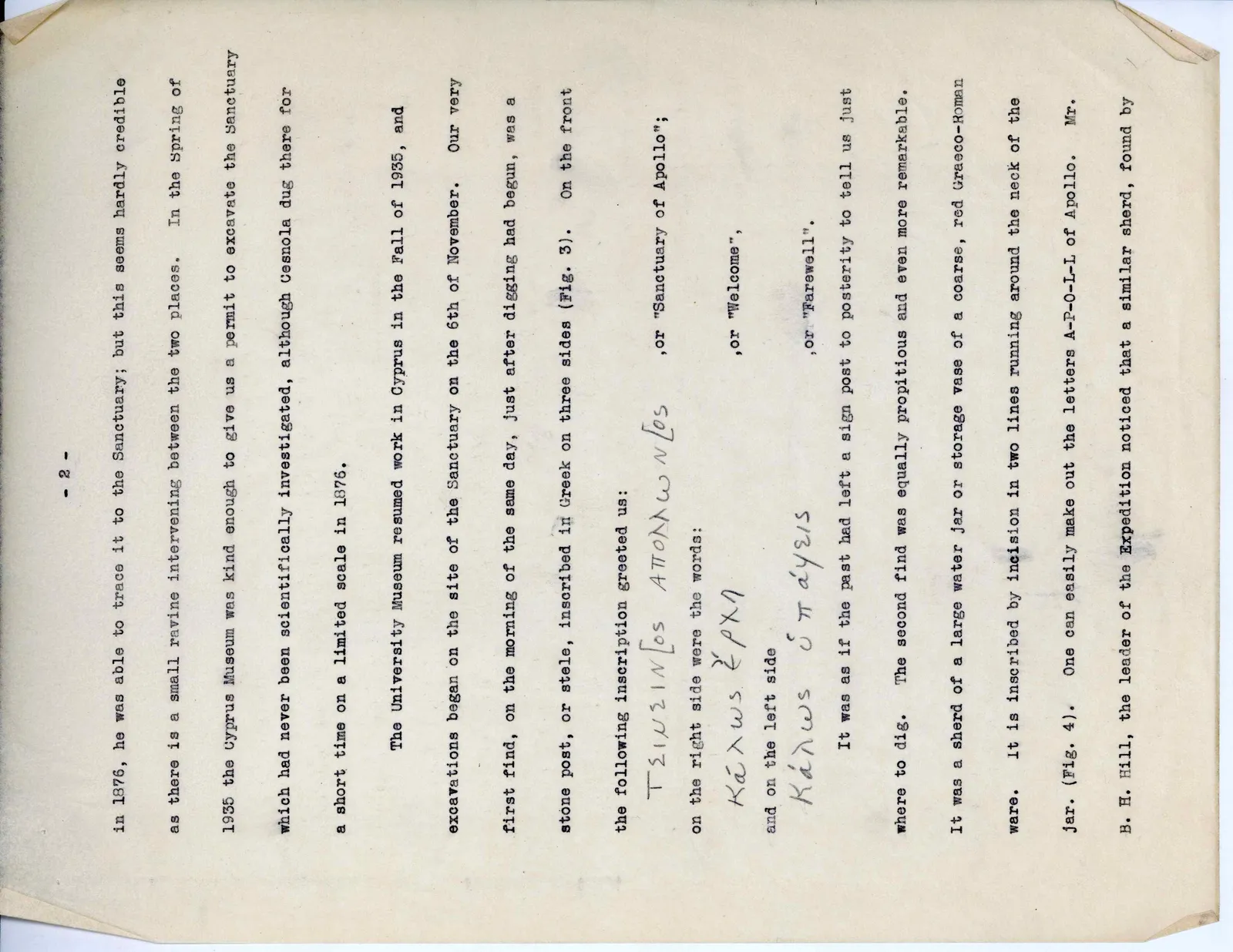
The University Museum resumed work in Cyprus in the Fall of 1935, and excavations began on the site of the Sanctuary on the 6th of November. Our very first find, on the morning of the same day, just after digging had begun, was a stone post, or stele, inscribed in Greek on three sides (Fig. 3). On the front the following inscription greeted us:
[handwritten: ΤΞΙΩΝΙΝΟΣ ΑΠΟΛΛΩΝΟΣ] ,or "Sanctuary of Apollo";
on the right side were the words: [handwritten: Καλῶς ἔρχη] ,or "Welcome",
and on the left side [handwritten: Καλῶς ὁ πάγεις] ,or "Farewell".
It was as if the past had left a sign post to posterity to tell us just where to dig. The second find was equally propitious and even more remarkable. It was a sherd of a large water jar or storage vase of a coarse, red Graeco-Roman ware. It is inscribed by incision in two lines running around the neck of the jar. (Fig. 4). One can easily make out the letters A-P-O-L-L-O of Apollo. Mr. B. H. Hill, the leader of the Expedition noticed that a similar sherd, found by
65 figures hard to readstruck struck outadded written in above” jug ditto, and what it repeatsword reading not certain