
Unnumbered pageScan 28 of 31
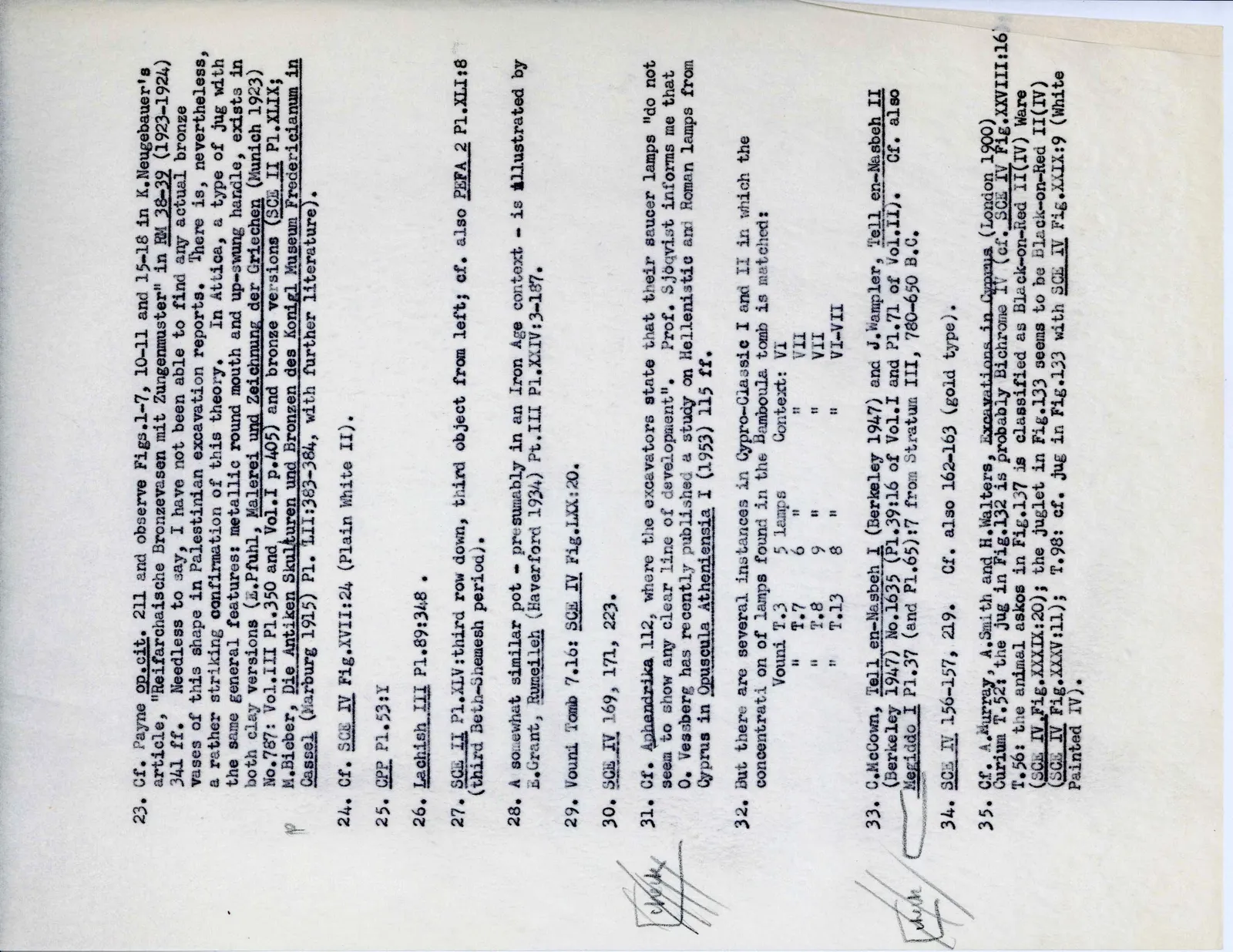
23. Cf. Payne op.cit. 211 and observe Figs.1-7, 10-11 and 15-18 in K.Neugebauer's article, "Reifarchaische Bronzevasen mit Zungenmuster" in RM 38-39 (1923-1924) 341 ff. Needless to say, I have not been able to find any actual bronze vases of this shape in Palestinian excavation reports. There is, nevertheless, a rather striking confirmation of this theory. In Attica, a type of jug with the same general features: metallic round mouth and up-swung handle, exists in both clay versions (E.Pfuhl, Malerei und Zeichnung der Griechen (Munich 1923) No.787: Vol.III Pl.350 and Vol.I p.405) and bronze versions (SCE II Pl.XLIX; M.Bieber, Die Antiken Skulpturen und Bronzen des Koniql Museum Frederiđicanum in Cassel (Marburg 1915) Pl. LII:383-384, with further literature).
24. Cf. SCE IV Fig.XVII:24 (Plain White II).
25. CPP Pl.53:Y
26. Lachish III Pl.89:348.
27. SCE II Pl.XLV:third row down, third object from left; cf. also PEFA 2 Pl.XLI:8 (third Beth-Shemesh period).
28. A somewhat similar pot - presumably in an Iron Age context - is illustrated by E.Grant, Rumeileh (Haverford 1934) Pt.III Pl.XXIV:3-197.
29. Vounì Tomb 7.16: SCE IV Fig.LXX:20.
30. SCE IV 169, 171, 223.
31. Cf. Aphendrika 112, where the excavators state that their saucer lamps "do not seem to show any clear line of development". Prof. Sjöqvist informs me that O. Vessberg has recently published a study on Hellenistic and Roman lamps from Cyprus in Opuscula Atheniensia I (1953) 115 ff.
32. But there are several instances in Cypro-Classic I and II in which the concentration of lamps found in the Bamboula tomb is matched:
| Vouni T.3 | 5 lamps | Context: VI |
| " T.7 | 6 | VII |
| " T.8 | 9 | VII |
| " T.13 | 8 | VI-VII |
33. C.McCown, Tell en-Nasbeh I (Berkeley 1947) and J.Wampler, Tell en-Nasbeh II (Berkeley 1947) No.1635 (Pl.39:16 of Vol.I and Pl.71 of Vol.II). Cf. also Megiddo I Pl.37 (and Pl.65):7 from Stratum III, 780-650 B.C.
34. SCE IV 156-157, 219. Cf. also 162-163 (gold type).
35. Cf. A.Murray, A.Smith and H.Walters, Excavations in Cyprus (London 1900) Curium T.52: the jug in Fig.132 is probably Bichrome IV (cf. SCE IV Fig.XXVIII:16 (SCE IV Fig.XXIX:20); the animal askos in Fig.137 is classified as Black-on-Red II(IV) Ware T.56: the juglet in Fig.133 seems to be Black-on-Red II(IV) (SCE IV Fig.XXXV:11); T.98: cf. jug in Fig.133 with SCE IV Fig.XXIX:9 (White Painted IV).
65 figures hard to readstruck struck outadded written in above” jug ditto, and what it repeatsword reading not certain