
Unnumbered pageScan 61 of 77
[margin left: Found in the topsoil of the southeast part of Area E.
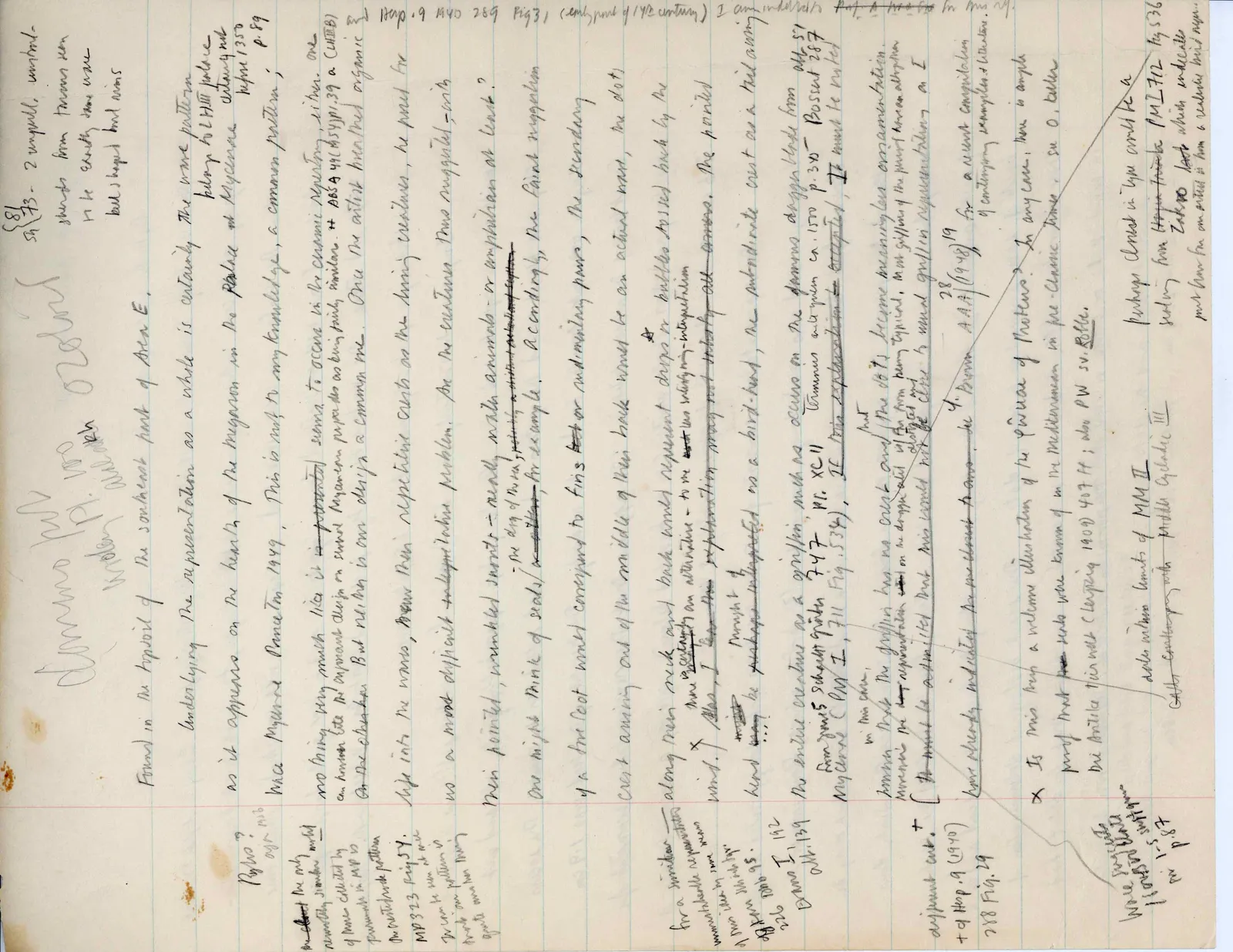
Underlying the representation as a whole is certainly the wave pattern as it appears on the hearth of the megaron in the Palace at Mycenae. Pylos? AJA 1956 [margin left: belongs to L H III palace, certainly not before 1350 p. 89] BSA 42 (1947) p. 39 a (LH IIIB) Hesperia 1949, This is not, to my knowledge, a common pattern; no thing very much like it is presented pictured seems to occur in the ceramic repertory, either. One can however cite the cognizant design on several Mycenaean pyxides as being fairly similar.+ On the other har But neither is our design a common one. Once the artist breathed organic life into the waves, drew their repetitive crests as the living creatures, he posed for us a most difficult interpretative problem. Are the creatures thus suggested, with their pointed, wrinkled snouts – really water animals – or amphibian at least? One might think of seals, – see dwg of these, probably a still ruder attempt – for example. Accordingly, the faint suggestion of a fore foot would correspond to fins, feet or rudimentary paws, the secondary crest arising out of the middle of their back would be an actual wave, the dot(drawing) along their neck and back would represent drops or bubbles tossed back by the wind. X more Also, I (drawing) is certainly an alternative – to me far less satisfying – interpretation may be perhaps interpreted thought of as a bird-head, the subordinate crest as a tail arising [margin left: for a similar unmistakeable representation of this idea by some means often illustrated: 226 BMB 95.] Evans I, 192 alt. 139 The entire creature as a griffin, such as occurs on the famous dagger blade from alt. 51 grave 5 Schachtgräber 747 Pl. XCII Terminus ante quem ca. 1500 p. 305 Bossert 287 Mycenae (PM I, 711 Fig. 538), in this case if this explanation is accepted; It must be noted [bracketed: not however that the griffin has no crest and the dots become meaningless ornamentation. Moreover, the representation on the dagger although far from being typical, for a recent computation of contemporary examples v. literature resembles much more closely the usual griffin than this one. [illegible] It must be admitted that this would not be close to usual griffin representations as I]
Bracketed: have already indicated and are closest to one in 4. Brown AAA 28 (1948)19 see O. Keller
die Antike Tierwelt (Leipzig 1909) 407 ff; also PW s.v. Robbe. X Is this then a welcome illustration of the "figure of Proteus? In any case, there is ample proof that p seals were known of in the Mediterranean in pre-Classical times.
dates between limits of MM II latter contemporary with Middle Cycladic III Perhaps closest in type would be a sealing from Hagia Triada PMI 712 Fig 536 Zakro seals which indicate not how far an artist # has a realistic bird repr.]
[margin left: { 58 59 73 - 2 unpubl. unintelsherds from Tarsus seem to be exactly same ware but shaped bowl rims
Faint mirror-image pencil script in center left margin
Woolley Pl. 100 Alalakh]
[illegibleabout the only remotely similar motif of those collected by Furumark in MP is the curtailed wave pattern MP 323 Fig 54. In can be seen at once that our pattern is quite another thing
thought of
+ cf Hesp. 9 (1940) 288 Fig. 29
Wave pug-cuts 1600 or so at least pm 1-5 shaft grave p. 87
and Hesp. 9 1940 289 Fig 31 (early part of 14th century) I am indebted to Prof. A W Persson for this ref.
65 figures hard to readstruck struck outadded written in above” jug ditto, and what it repeatsword reading not certain