
Unnumbered pageScan 48 of 77
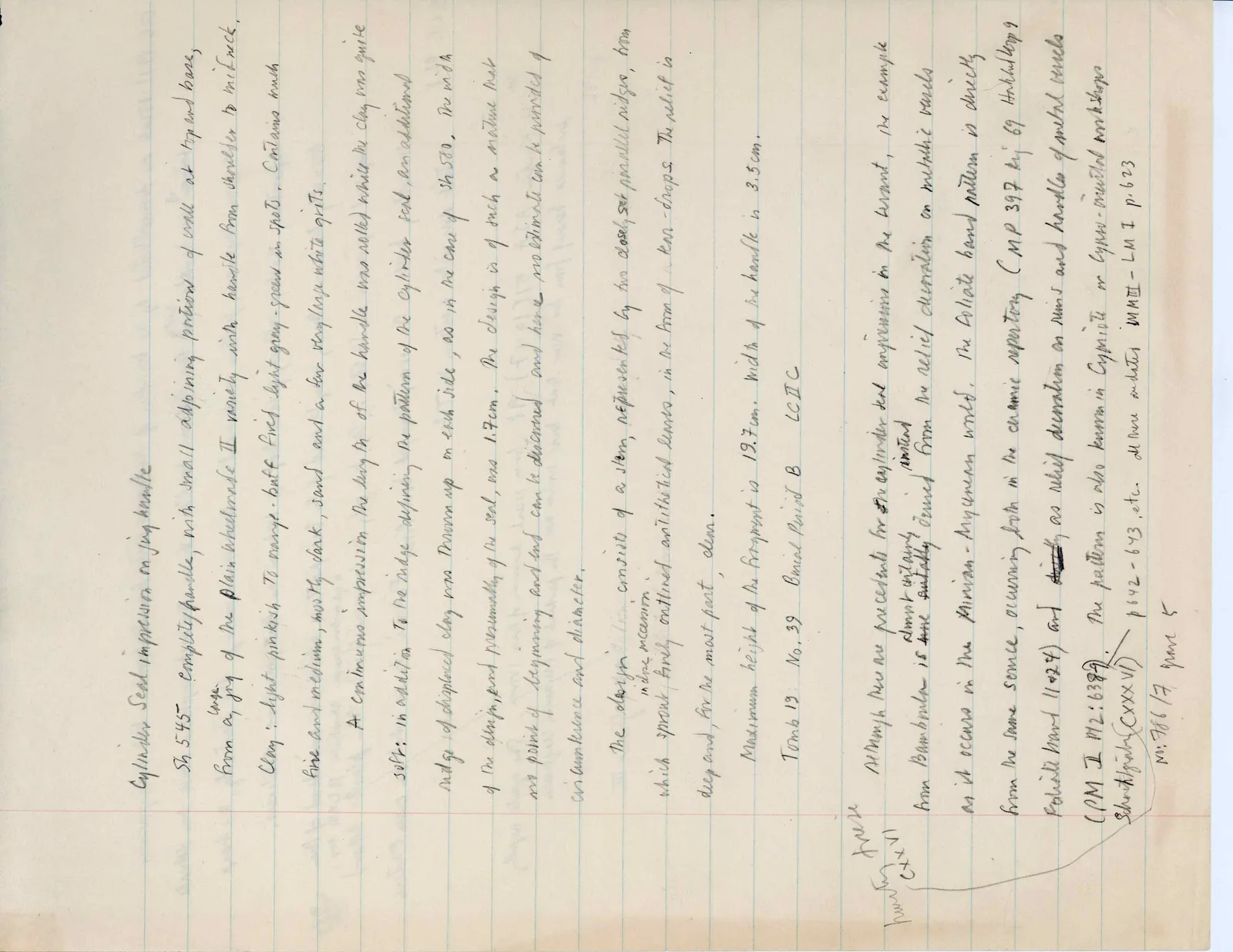
Cylinder Seal Impression on jug handle
Sh 545 Complete handle, with small adjoining portion of wall at top and base, from a, jug of the Plain Wheelmade II variety with handle from shoulder to mid neck. Clay: Light pinkish to orange-buff. Fired light gray-green in spots. Contains much fine and medium, mostly dark, sand and a few very large white grits.
A continuous impression the length of the handle was rolled while the clay was quite soft: in addition to the ridge defining the pattern of the cylinder seal, an additional ridge of displaced clay was thrown up on each side, as in the case of Sh 580. The width of the design, and presumably of the seal, was 1.7 cm. The design is of such a nature that no point of beginning and end can be discerned and hence no estimate can be provided of circumference and diameter.
The design [illegible] consists of a stem, represented by two closely set parallel ridges, from which sprout finely outlined antithetical leaves, in the form of tear-drops. The relief is deep and, for the most part, clean.
Maximum height of the fragment is 19.7 cm. Width of the handle is 3.5 cm.
Tomb 19: No. 39 Burial Period B LC II C
[margin left: Hunting freize CXXVI] Although there are precedents for the cylinder seal impressions in the Levant, the example from Bamboula is almost certainly doubtless derived from the relief decoration on metallic vessels as it occurs in the Minoan-Mycenaean world. The foliate band pattern is directly from the same source, occurring both in the ceramic repertory (MP 397 fig. 69 Habitually Motip 9 foliate band 11-24) and [illegible], as relief decoration on rims and handles of metal vessels (PM II 142:638 b). The pattern is also known in Cypriote or Cypro-Mycenaean workshops Schweitzer (CXXXVI) p642-643, etc. All these are dated MM III - LM I p.623 No. 786/7 grave 5
65 figures hard to readstruck struck outadded written in above” jug ditto, and what it repeatsword reading not certain