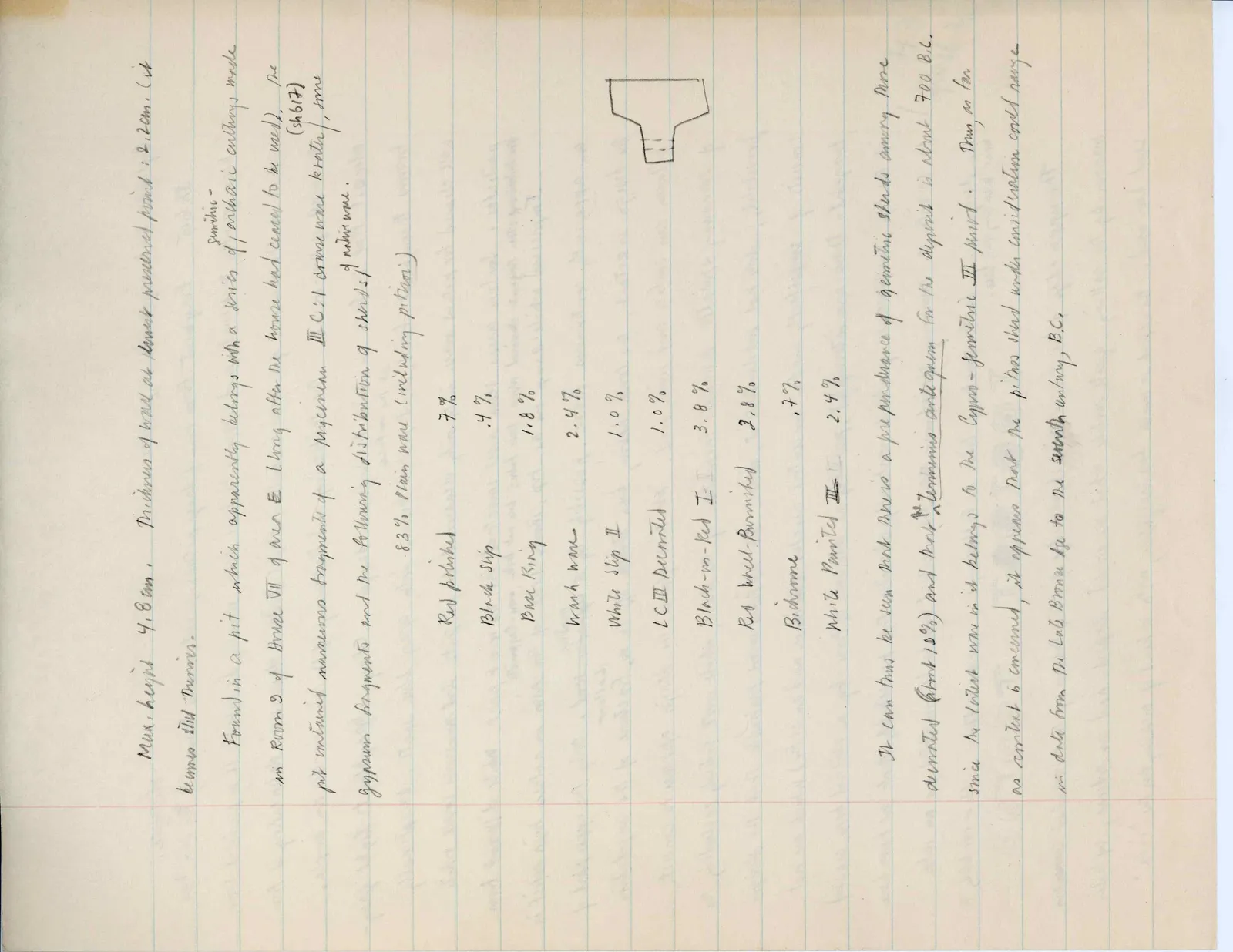
Max. height 4.8 cm. Thickness of wall at lowest preserved point : 2.2 cm. (itbecomes still thinner.
Found in a pit which apparently belongs with a series of primitive archaic cuttings madein Room 2 of House VII of Area E (long after the house had ceased to be used). Thepit contained numerous fragments of a Mycenaean III C:1 coarse ware krater (sh 617), somegypsum fragments and the following distribution of sherds of native ware:
83% Plain ware (including pithoi)
Red polished
.7%
Black slip
.4%
Base Ring
1.8%
Wash ware
2.4%
White Slip II
1.0%
LCIII Decorated
1.0%
Black-on-Red I-II
3.8%
Red Wheel-Burnished
2.8%
Bichrome
.7%
White Painted III
2.4%
Drawing: profile of vessel with handle or neck stump; labels: none
It can thus be seen that there is a preponderance of geometric sherds among thosedecorated (about 10%) and that the terminus ante quem for the deposit is about 700 B.C.since the latest ware in it belongs to the Cypro-Geometric III period. Thus, as faras context is concerned, it appears that the pithos sherd under consideration could rangein date from the Late Bronze Age to the seventh century, B.C.
65 figures hard to readstruck struck outadded written in above”jug ditto, and what it repeatsword reading not certain