
Unnumbered pageScan 34 of 77
5
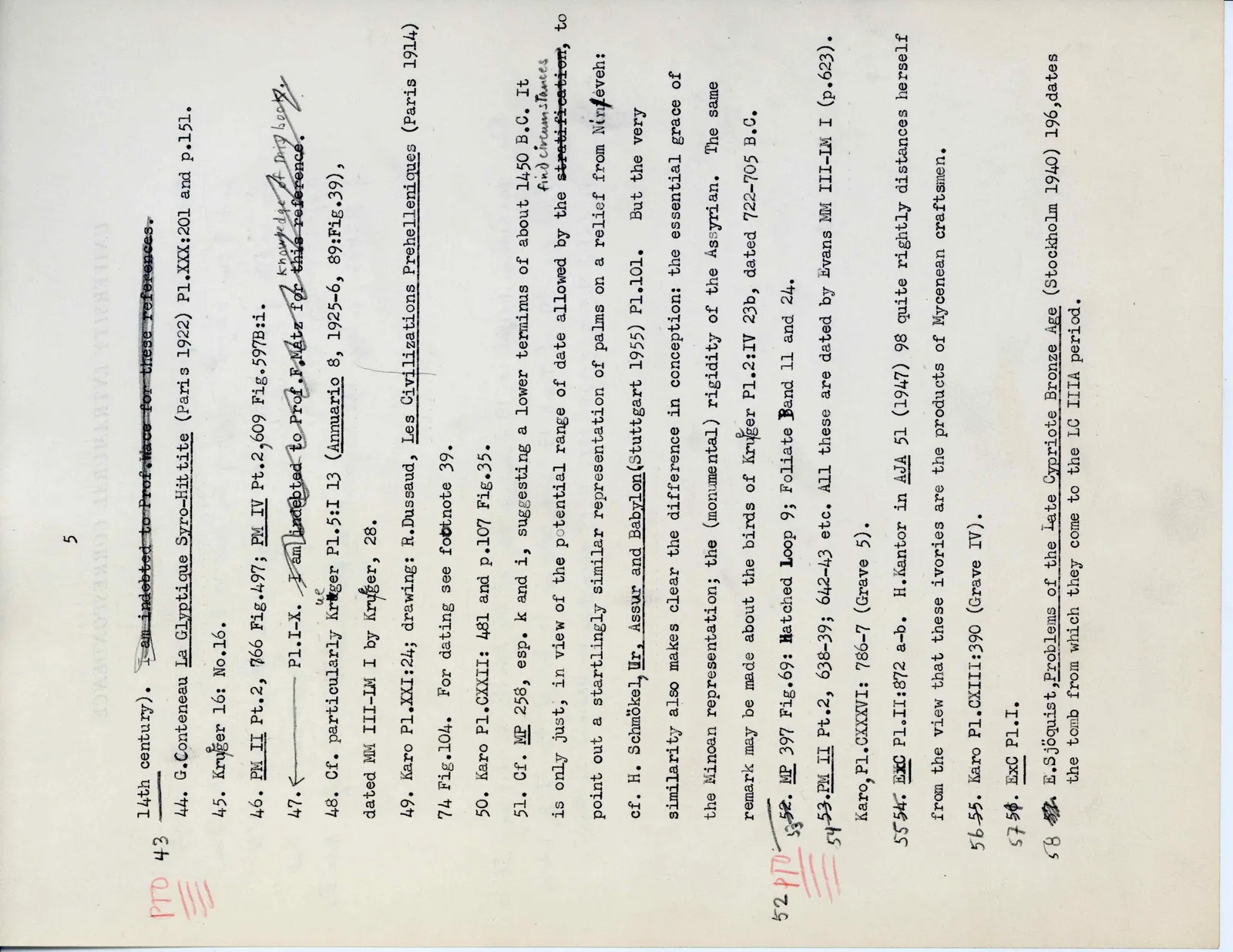
14th century). 43 44. G.Conteneau La Glyptique Syro-Hittite (Paris 1922) Pl.XXX:201 and p.151. 45. Kruger 16: No.16. 46. PM II Pt.2, 766 Fig.497; PM IV Pt.2,609 Fig.597B:i. 47. [handwritten: I am indebted to Prof. Mace for these references.] Pl.I-X. [handwritten: ue] 48. Cf. particularly Kruger Pl.5:I 13 (Annuario 8, 1925-6, 89:Fig.39), dated MM III-LM I by Kruger, 28. 49. Karo Pl.XXI:24; drawing: R.Dussaud, Les Civilizations Prehelleniques (Paris 1914) 74 Fig.104. For dating see footnote 39. 50. Karo Pl.CXXII: 481 and p.107 Fig.35. 51. Cf. MP 258, esp. k and i, suggesting a lower terminus of about 1450 B.C. It is only just, in view of the potential range of date allowed by the stratification, to point out a startlingly similar representation of palms on a relief from Nineveh: cf. H. Schmökel, Ur, Assur and Babylon (Stuttgart 1955) Pl.101. But the very similarity also makes clear the difference in conception: the essential grace of the Minoan representation; the (monumental) rigidity of the Assyrian. The same remark may be made about the birds of Kruger Pl.2:IV 23b, dated 722-705 B.C. 52. MP 397 Fig.69: Hatched Loop 9; Foliate Band 11 and 24 53. PM II Pt.2, 638-39; 642-43 etc. All these are dated by Evans MM III-LM I (p.623). Karo, Pl.CXXXVI: 786-7 (Grave 5). 54. ExC Pl.II:872 a-b. H.Kantor in AJA 51 (1947) 98 quite rightly distances herself from the view that these ivories are the products of Mycenean craftsmen. 55. Karo Pl.CXIII:390 (Grave IV). 56. ExC Pl.I. 57. E.S Jöquist, Problems of the Late Cypriote Bronze Age (Stockholm 1940) 196,dates the tomb from which they come to the LC IIIA period. 58.
65 figures hard to readstruck struck outadded written in above” jug ditto, and what it repeatsword reading not certain