
Unnumbered pageScan 24 of 77
19
UNIVERSITY MUSEUM CORRESPONDENCE [printed: header, faint]
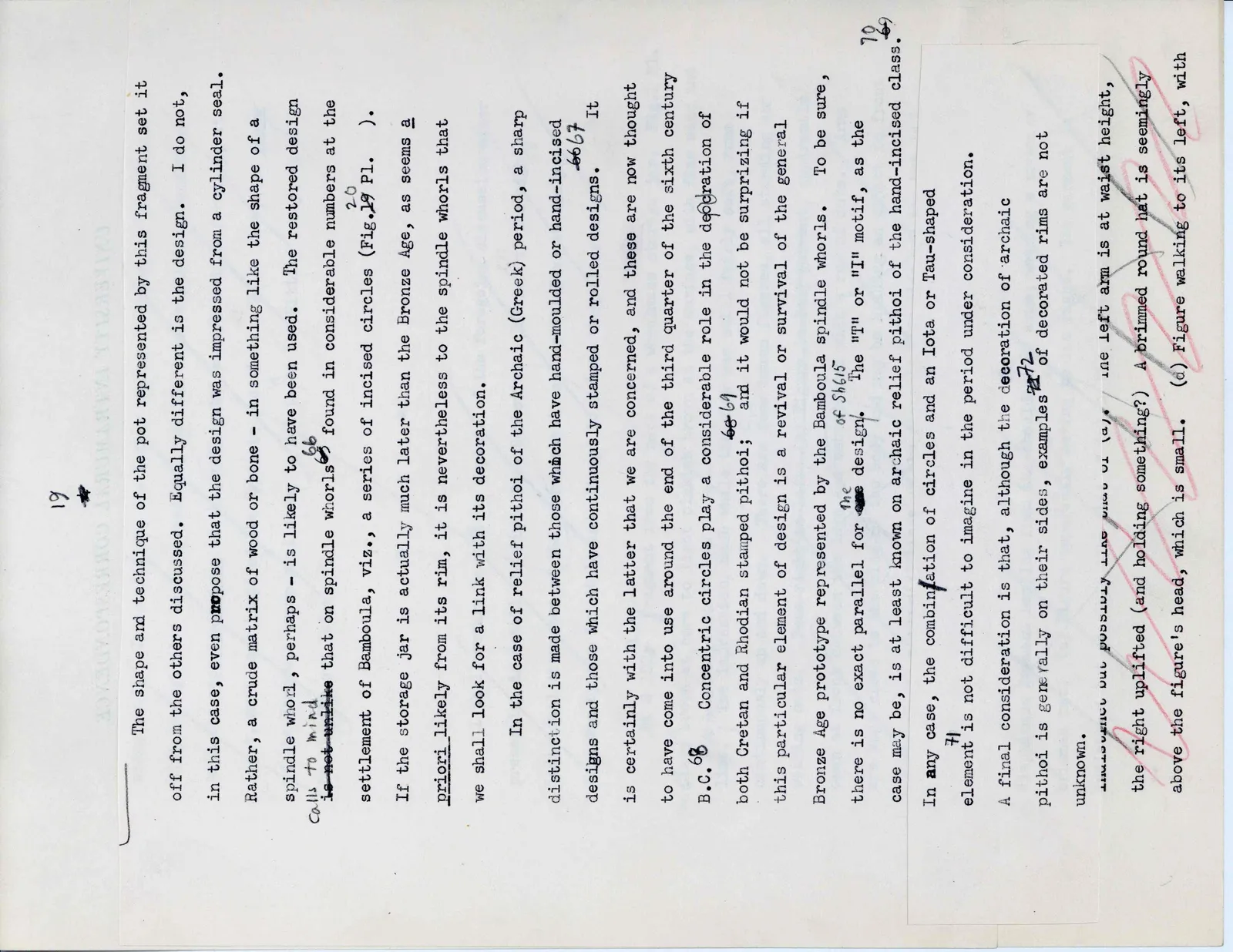
The shape and technique of the pot represented by this fragment set it off from the others discussed. Equally different is the design. I do not, in this case, even propose that the design was impressed from a cylinder seal. Rather, a crude matrix of wood or bone - in something like the shape of a spindle whorl, perhaps - is likely to have been used. The restored design that on spindle whorls [handwritten: 66] found in considerable numbers at the is not unlike settlement of Bamboula, viz., a series of incised circles (Fig. 19 Pl. [handwritten: 20]). If the storage jar is actually much later than the Bronze Age, as seems a priori likely from its rim, it is nevertheless to the spindle whorls that we shall look for a link with its decoration. In the case of relief pithoi of the Archaic (Greek) period, a sharp distinction is made between those which have hand-moulded or hand-incised designs and those which have continuously stamped or rolled designs. [handwritten: 66 67] It is certainly with the latter that we are concerned, and these are now thought to have come into use around the end of the third quarter of the sixth century B.C. [handwritten: 68 69]. Concentric circles play a considerable role in the decoration of both Cretan and Rhodian stamped pithoi; and it would not be surprizing if this particular element of design is a revival or survival of the general [handwritten: the] design. Bronze Age prototype represented by the Bamboula spindle whorls. To be sure, there is no exact parallel for [handwritten: of S6615] the "T" or "I" motif, as the case may be, is at least known on archaic relief pithoi of the hand-incised class. [handwritten: 70 71] In any case, the combination of circles and an Iota or Tau-shaped element is not difficult to imagine in the period under consideration. A final consideration is that, although the decoration of archaic pithoi is generally on their sides, examples [handwritten: 72] of decorated rims are not unknown.
Right page
...the left arm is at waist height, the right uplifted (and holding something?) A brimmed round hat is seemingly ... possibly the ... above the figure's head, walking to its left, with (a) ... [illegible]
65 figures hard to readstruck struck outadded written in above” jug ditto, and what it repeatsword reading not certain