
Unnumbered pageScan 11 of 77
Continued from scan 10
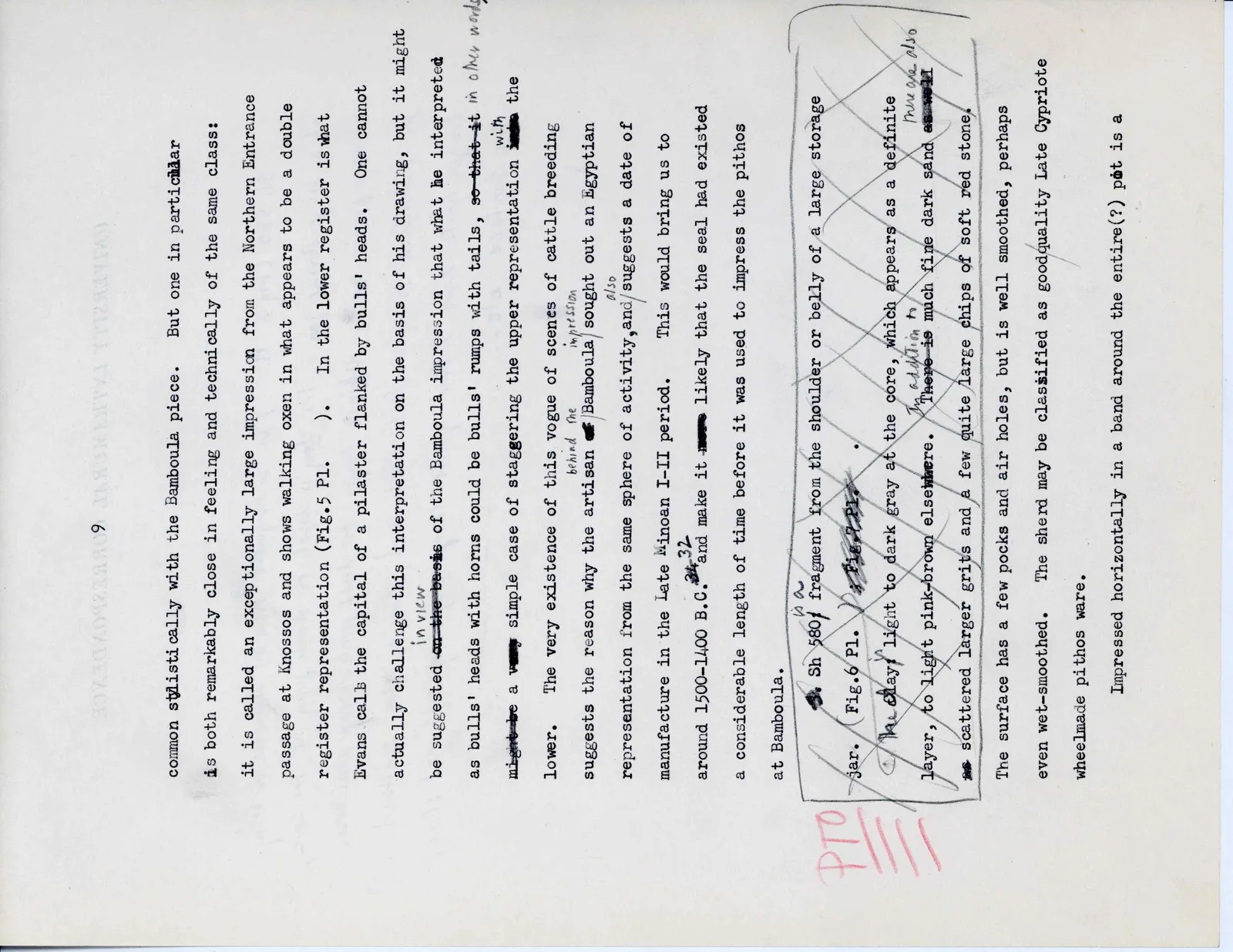
… common stylistically with the Bamboula piece. But one in particular is both remarkably close in feeling and technically of the same class: it is called an exceptionally large impression from the Northern Entrance passage at Knossos and shows walking oxen in what appears to be a double register representation (Fig.5 Pl. ). In the lower register is what Evans call the capital of a pilaster flanked by bulls' heads. One cannot actually challenge this interpretation on the basis of his drawing, but it might be suggested [handwritten: in view] on the basis of the Bamboula impression that what he interpreted as bulls' heads with horns could be bulls' rumps with tails, so that [handwritten: it in other words] might be a very simple case of staggering the upper representation [handwritten: with] the lower. The very existence of this vogue of scenes of cattle breeding suggests the reason why the artisan [handwritten: behind the] Bamboula [handwritten: impression] sought out an Egyptian representation from the same sphere of activity, [handwritten: also] suggests a date of around 1500-1400 B.C. [handwritten: 34-32] and make it likely that the seal had existed a considerable length of time before it was used to impress the pithos at Bamboula.
[handwritten: Pl.111] Sh 580 fragment from the shoulder or belly of a large storage jar. (Fig.6 Pl. [handwritten: Fig.7 Pl.]) Clay: light to dark gray at the core, which appears as a definite layer, to light pink-brown elsewhere. There is much fine dark sand [handwritten: and also] scattered larger grits and a few quite large chips of soft red stone. The surface has a few pocks and air holes, but is well smoothed, perhaps even wet-smoothed. The sherd may be classified as good quality Late Cypriote wheelmade pithos ware.
Impressed horizontally in a band around the entire(?) pot is a
65 figures hard to readstruck struck outadded written in above” jug ditto, and what it repeatsword reading not certain