
Unnumbered pageScan 72 of 88
3
to the ANS for publication, that is ok. Then I think as the guiding hand of the enterprise I think you should write the introductory note.
If this note is as comprehensive as you suggest then I could delete all historical comment. Since I have no information on any of the points raised under 3) b) I cannot possibly cope. You say that an analysis of the coins found in the Theatre and in the Sanctuary would be significant. Certainly they would be, but are they are the results applicable to Curium as a whole or to those two areas? On p. 11 of Roman Commentary, under 5" and 6" Cent. coins, I made remarks about the aquaduct and at the time wondered whether that had not best be left to the person writing on that area. In writing up any of these sections the coins as evidence will have to be considered; in how much detail is it worth doing it it twice? I should think here the barest limits with some idea of volume was enough.
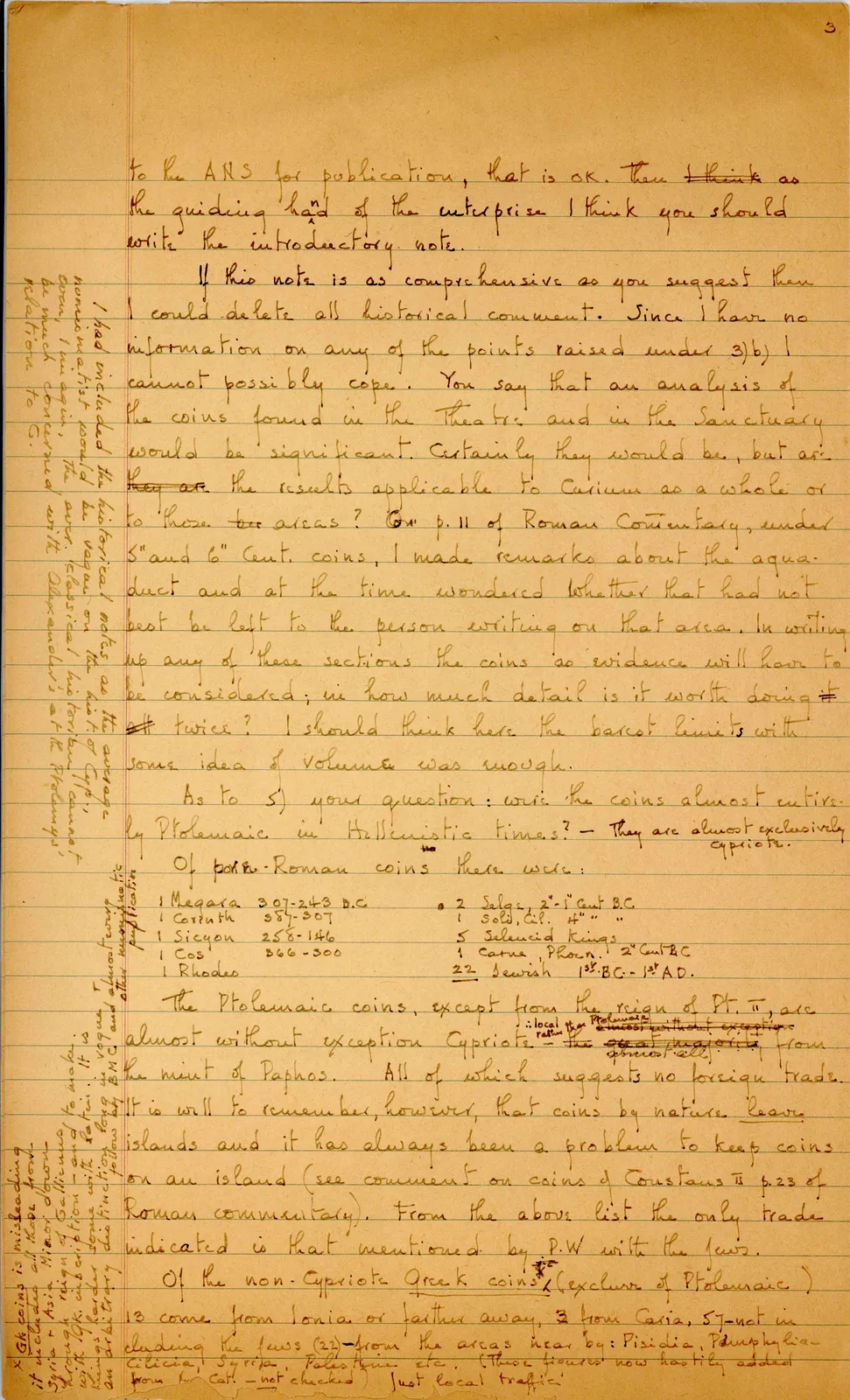
As to 5) your question: were the coins almost entirely Ptolemaic in Hellenistic times? - They are almost exclusively Cypriote.
^[?*^ I had included the historical notes as the average numismatist would be vague on the hist. of Cyp. Even, I may again, the aver. classical historian cannot be much concerned with Alexander's at the Phalanx' relation to C.] Of ^non- Roman coins there were:
| 1 Megara 307-243 B.C. | 2 Selge, 2"-1" Cent B.C. |
| 1 Corinth 387-307 | 1 Soli, Cil. 4" " " |
| 1 Sicyon 258-146 | 5 Seleucid Kings |
| 1 Cos 366-300 | 1 Carne, Phoen. 2" Cent B.C |
| 1 Rhodes | 22 Jewish 1st. B.C. - 1st A.D. |
[margin left: * Gk coins is misleading it includes all those from Syria & Asia Minor down through reign of Gallienus, to make things harder some with Latin! It is an arbitrary distinction long in vogue & almost every follow by BMC and other numismatic publication] The Ptolemaic coins, except from the reign of Pt. II, are almost without exception Cypriote local thesPtolemaic - the great majority almost all from the mint of Paphos. All of which suggests no foreign trade. It is well to remember, however, that coins by nature leave islands and it has always been a problem to keep coins on an island (see comment on coins of Constans II p. 23 of Roman commentary). From the above list the only trade indicated is that mentioned by P.W. with the Jews.
xOf the non-Cypriote Greek coins*(exclusive of Ptolemaic) 13 come from Ionia or farther away, 3 from Caria, 57 - not in cluding the Jews (22) - from the areas near by: Pisidia, Pamphylia Cilicia, Syria, Palestine etc. (These figures now hastily added from hr cat. - not checked) Just local traffic.
65 figures hard to readstruck struck outadded written in above” jug ditto, and what it repeatsword reading not certain