
Unnumbered pageScan 6 of 94
On "The Sanctuary of Apollo at Curium (Kourion)", pp 1-6
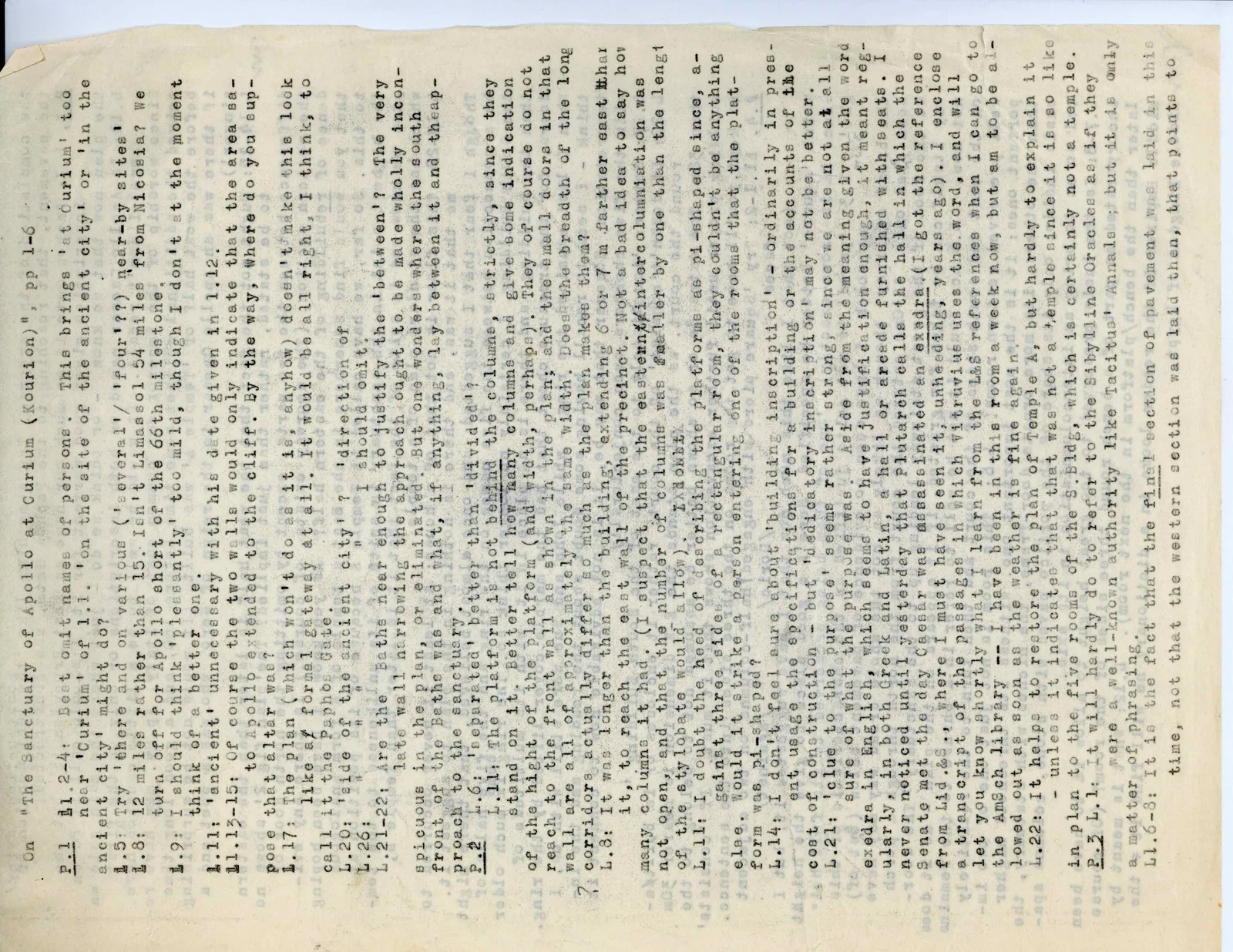
p.1 Ll.2-4: Best omit names of persons. This brings 'at Curium' too near 'Curium' might do? 'in the ancient city' or 'in the ancient city' [handwritten: ?] on the site of the ancient city' or 'in the ancient city'? 'near-by sites' l.5: Try 'there and on various ('several'/'four'??) near-by sites' l.8: 12 miles rather than 15. Isn't Limassol 54 miles from Nicosia? We turn off for Apollo short of the 66th milestone. l.9: I should think 'pleasantly' too mild, though I don't at the moment think of a better one. l.11: 'ancient' unnecessary with his date given in l.12. ll.13-15: Of course the two walls would only indicate that the area-to Apollo extended to the cliff. By the way, where do you suppose that altar was? L.17: The plan (which won't do as it is, anyhow) doesn't make this look like a formal gateway at all. It would be all right, I think, to call it the Paphos Gate. L.20: 'side of the ancient city'? [handwritten: I should omit.] L.26: 'direction of approach to the sanctuary' better than 'divided'? L.21-22: Are the Baths near enough to justify the 'between'? The very late wall narrowing the approach ought to be made wholly inconspicuous in the plan, or eliminated. But one wonders where the south front of the Baths was and what, if anything, lay between it and theapp.2 L.6: 'separated' better than 'divided' ? L.11: The platform is not behind the columns, strictly, since they stand on it. Better tell how many columns and give some indication of the height of the platform (and width, plan; perhaps). They of course do not reach to the front wall as shown in the plan; and the small doors in that wall are all of approximately the same width. Does the breadth of the long corridors actually differ so much as the plan makes them? L.8: It was longer than the east wall of the building, extending 6 or 7 m farther east than the eastern/wintercolumniation was not open, and that the number of columns it had. (I suspect that the precinct. Not a bad idea to say how many columns it had would allow) L.11: I doubt the head of describing the platforms as pi-shaped since, a-gainst three sides of a rectangular room, they couldn't be anything else. would it strike a person entering one of the rooms that the platform was pi-shaped? L.14: I don't feel sure about 'building inscription' - ordinarily in press-ent usage the specifications for a building or the accounts of the dedicatory inscription' may not be better. L.21: 'clue to the purpose' seems rather strong, since we are not at all sure of what the purpose was. Aside from the meaning given the word exedra in English, which seems to have justification enough, it meant regularly, in both Greek and Latin, a hall or arcade furnished with seats. I never noticed until yesterday that Plutarch calls the hall in which the senate met the day Caesar was assassinated an exedra (I got the reference from Lid. & S., where I must have seen it, unheeding, years ago). I enclose and will let you know shortly what I learn from the LSJ references when I go to the Amsch library -- I have been in this room a week now, and will lowed out as soon as the weather is fine again. but am to be all-the Amsch library -- I have been in this room a week now, but hardly to explain it L.22: It helps to restore the plan of Temple A, but hardly to explain it - unless it indicates that that was not a temple. Since it is certainly not a temple, which is so like in plan to the five rooms of the S. Bldg, which I hardly do to refer to the Sibylline Oracles as if they were a well-known authority like Tacitus' Annals; but it is only a matter of phrasing. P.3 L.1: It will hardly do to refer to the Sibylline Oracles as if they were a well-known authority like Tacitus' Annals; but it is only a matter of phrasing. Ll.6-8: It is the fact that the final section of pavement was laid in this time, not that the western section was laid then, that points to … continues
65 figures hard to readstruck struck outadded written in above” jug ditto, and what it repeatsword reading not certain