
Unnumbered pageScan 40 of 41
-9-
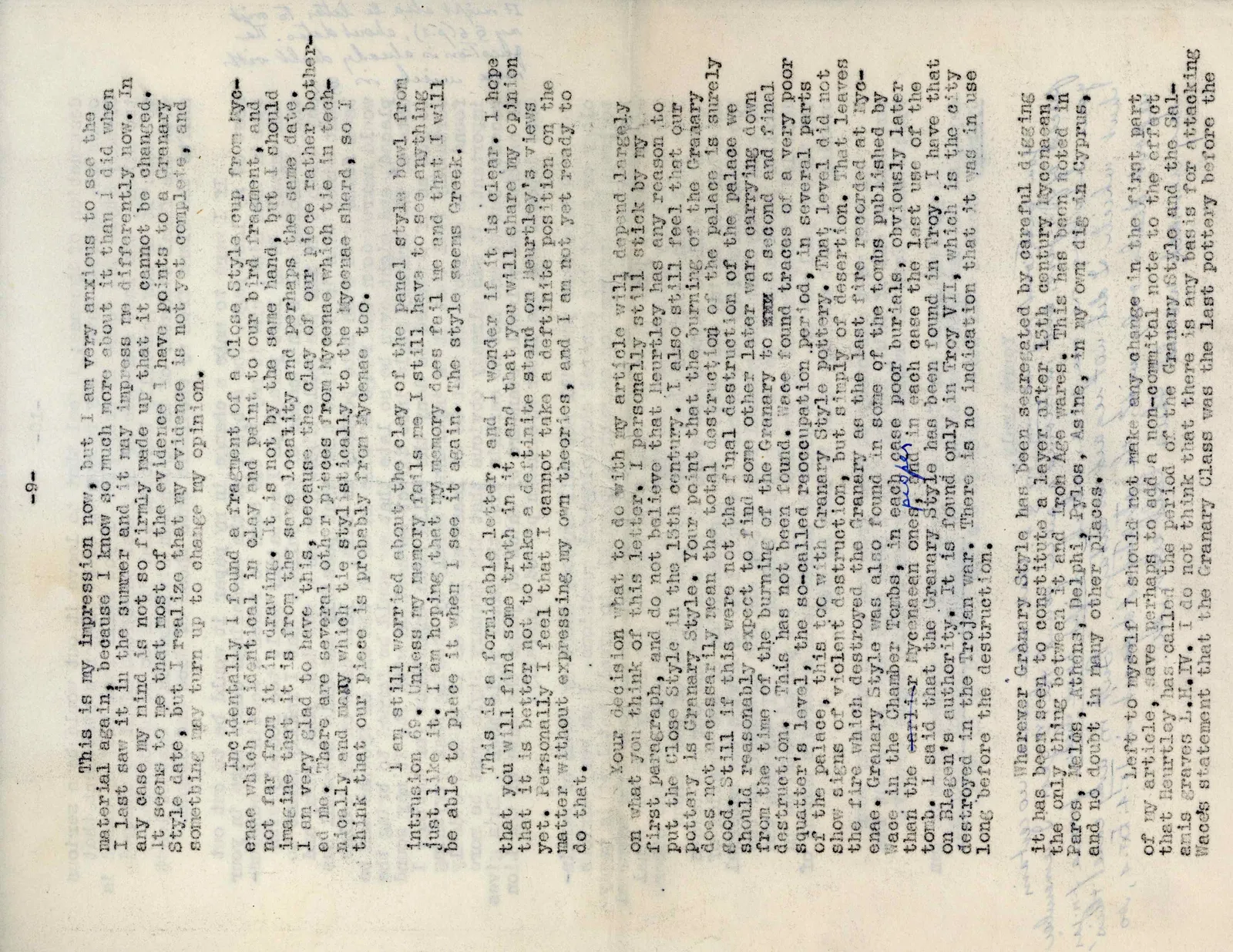
This is my impression now, but I am very anxious to see the material again, because I know so much more about it than I did when I last saw it in the summer and it may impress me differently now. In any case my mind is not so firmly made up that it cannot be changed. It seems to me that most of the evidence I have points to a Granary Style date, but I realize that my evidence is not yet complete, and something may turn up to change my opinion.
Incidentally I found a fragment of a close Style cup from Myc-enae which is identical in clay and paint to our bird fragment, and not far from it in drawing. It is not by the same hand, but I should imagine that it is from the same locality and perhaps the same date. I am very glad to have this, because the clay of our piece rather bothers me. There are several other pieces from Mycenae which tie in technically and many which tie stylistically to the Mycenae sherd, so I think that our piece is probably from Mycenae too.
I am still worried about the clay of the panel style bowl from Intrusion 68. Unless my memory fails me I still have to see anything just like it. I am hoping that my memory does fail me and that I will be able to place it when I see it again. The style seems Greek.
This is a formidable letter, and I wonder if it is clear. I hope that you will find some truth in it, and that you will share my opinion that it is better not to take a definite stand on Heurtley's views yet. Personally I feel that I cannot take a definite position on the matter without expressing my own theories, and I am not yet ready to do that.
Your decision what to do with my article will depend largely on what you think of this letter. I personally still stick by my first paragraph, and do not believe that Heurtley has any reason to put the Close Style in the 15th century. I also still feel that our pottery is Granary Style. Your point that the burning of the Granary does not necessarily mean the total destruction of the palace is surely good. Still if this were not the final destruction of the palace we should reasonably expect to find some other later ware carrying down from the time of the burning of the Granary to mm a second and final destruction. This has not been found. Ware found traces of a very poor squatter's level, the so-called reoccupation period, in several parts of the palace, this too with Granary Style pottery. That level did not show signs of violent destruction, but simply of desertion. That leaves the fire which destroyed the Granary as the last fire recorded at Myc-enae. Granary Style was also found in some of the tombs published by Wace in the Chamber Tombs, in each case poor burials, obviously later than the earlier Mycenaean ones, and in each case the last use of the tomb. I said that the Granary Style has been found in Troy, I have that on Blegen's authority. It is found only in Troy VII, which is the city destroyed in the Trojan war. There is no indication that it was in use long before the destruction.
Wherever Granary Style has been seen to constitute a layer after 15th century Lyconaean, the only thing between it and Iron Age wares. This has been noted in Paros, Melos, Athens, Delphi, Pylos, Asine, in my own dig in Cyprus, and no doubt in many other places.
Left to myself I should not make any change in the first part of my article, save perhaps to add a non-committal note to the effect that Heurtley has called the period of the Granary Style and the Sal-amis graves I.H.IV. I do not think that there is any basis for attacking Wace's statement that the Granary class was the last pottery before the destruction.
65 figures hard to readstruck struck outadded written in above” jug ditto, and what it repeatsword reading not certain