
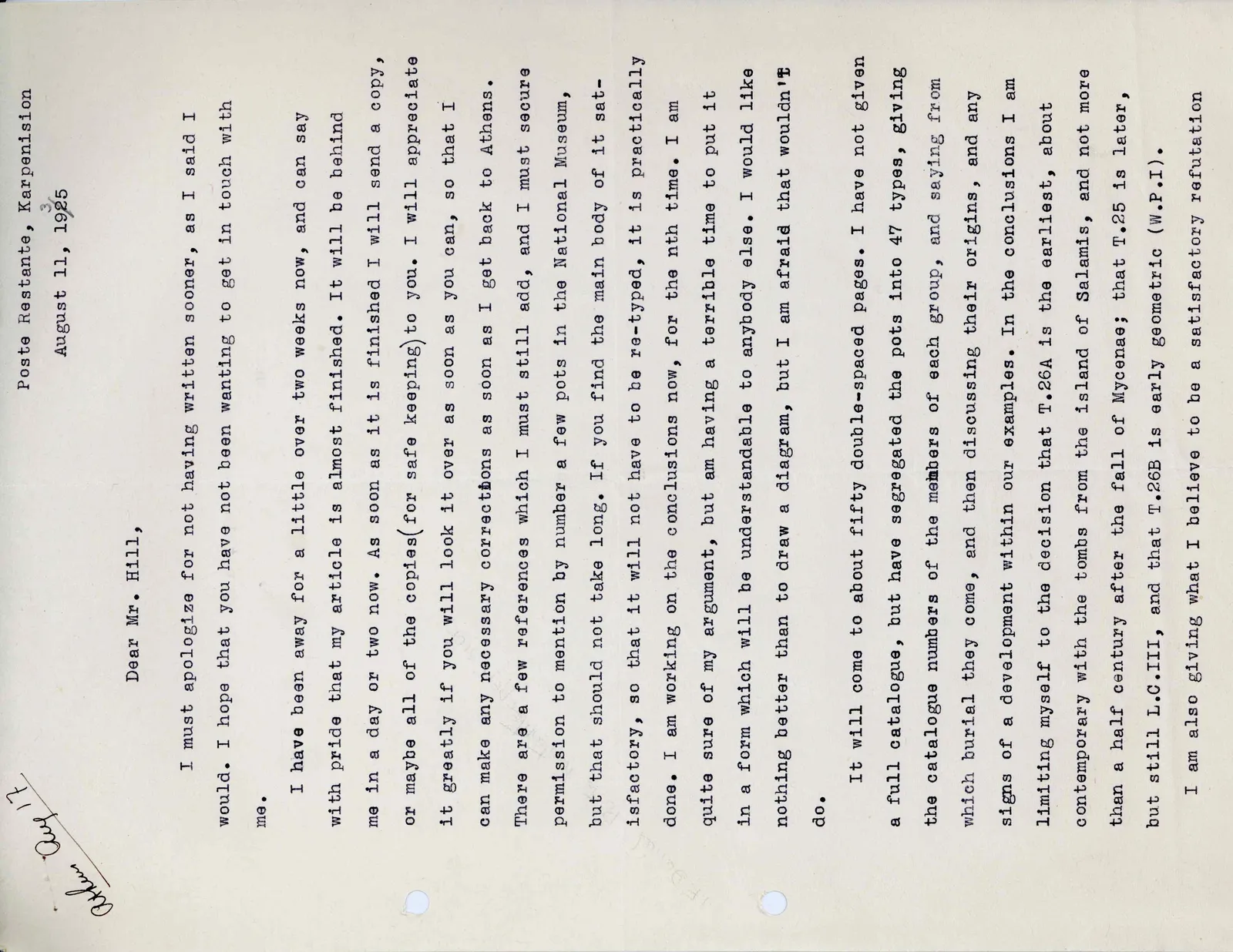
Unnumbered pageScan 27 of 72
Poste Restante, Karpenision August 11, 1925
Dear Mr. Hill,
I must apologize for not having written sooner, as I said I would. I hope that you have not been wanting to get in touch with me.
I have been away for a little over two weeks now, and can say with pride that my article is almost finished. It will be behind me in a day or two now. As soon as it is finished I will send a copy, or maybe all of the copies (for safe keeping) to you. I will appreciate it greatly if you will look it over as soon as you can, so that I can make any necessary corrections as soon as I get back to Athens.
There are a few references which I must still add, and I must secure permission to mention by number a few pots in the National Museum, but that should not take long. If you find the main body of it satisfactory, so that it will not have to be re-typed, it is practically done. I am working on the conclusions now, for the nth time. I am quite sure of my argument, but am having a terrible time to put it in a form which will be understandable to anybody else. I would like nothing better than to draw a diagram, but I am afraid that wouldn't do.
It will come to about fifty double-spaced pages. I have not given a full catalogue, but have segregated the pots into 47 types, giving the catalogue numbers of the members of each group, and saying from which burial they come, and then discussing their origins, and any signs of a development within our examples. In the conclusions I am limiting myself to the decision that T.26A is the earliest, about contemporary with the tombs from the island of Salamis, and not more than a half century after the fall of Mycenae; that T.25 is later, but still L.C.III, and that T.26B is early geometric (W.P.I).
I am also giving what I believe to be a satisfactory refutation … continues
65 figures hard to readstruck struck outadded written in above” jug ditto, and what it repeatsword reading not certain